
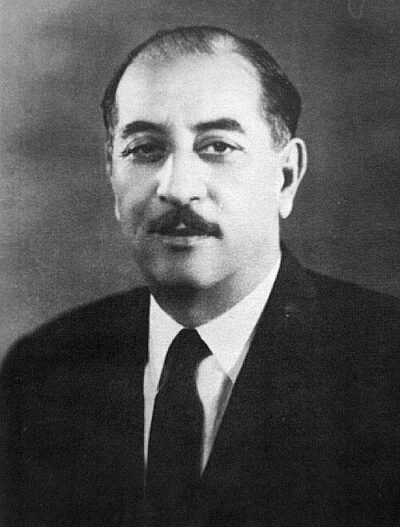
Ahmed Hassan al-Bakr
Ahmed Hassan al-Bakr was an Iraqi president. Born July 1, 1914, in Tikrit. Died October 4, 1982, in Baghdad. Positions held include Prime Minister of Iraq (2 times) (1963–1979), President of Iraq (1968–1979) and Minister of Defense (1974–1977). Educated at Iraqi Military Academy Rustamiyah. Awards include Collar of the Order of Isabella the Catholic and Grand Cross of the Order of Polonia Restituta.
Facts
26 facts · 2 confirmed by two sources · 6 cited · 18 from one source
Where this comes from
Papalocal keeps its own record. It started from these sources; what each one said is kept here as it was copied, so a change on their side never changes this page by itself. Tap one to read its version.
What Wikidata says · copied November 16, 2026 · revision 2567617388
- Described as
- Iraqi president (1914–1982)
- Other names
- Ahmed Hassan Bakr Omar
- Born
- July 1, 1914 · 5 references
- Died
- October 4, 1982 · 6 references
- Born in
- Tikrit · 1 reference
- Died in
- Baghdad · 1 reference
- Buried in
- Baghdad
- Citizen of
- Ottoman Empire; Kingdom of Iraq; First Republic of Iraq; Ba'athist Iraq
- Occupation
- politician · 1 reference; military personnel · 1 reference; head of government · 1 reference; statesperson
- Positions held
- Prime Minister of Iraq (2 times) (1963–1979); President of Iraq (1968–1979) · 1 reference; Minister of Defense (1974–1977) · 1 reference; president · 1 reference; Vice President of Iraq (1963–1964) · 1 reference
- Political party
- Ba'ath Party (–1966); Arab Socialist Ba'ath Party – Iraq Region (1966–1982)
- Education
- Iraqi Military Academy Rustamiyah
- Awards
- Collar of the Order of Isabella the Catholic (1978) · 1 reference; Grand Cross of the Order of Polonia Restituta · 1 reference
- Religion
- Sunni Islam
- Military branch
- Iraqi Army · 1 reference
- Military rank
- general · 1 reference
- Wikipedias with a page
- 52
Wikidata item Q238046 (wikidata.org/wiki/Q238046), public domain (CC0). Copied November 16, 2026.
What Wikipedia says · copied November 16, 2026 · revision 1380775343
Ahmed Hassan al-Bakr (1 July 1914 – 4 October 1982) was an Iraqi military officer and politician who served as the fourth president of Iraq from 1968 to 1979. He was a leading member of the revolutionary Arab Socialist Ba'ath Party and later the Baghdad-based Ba'ath Party and its regional organisation Ba'ath Party – Iraq Region (the Ba'ath Party's Iraqi branch), which espoused Ba'athism, a mix of Arab nationalism and Arab socialism.
Al-Bakr first rose to prominence after the 14 July Revolution, which overthrew the monarchy. In the newly established government, he was involved in improving Iraqi–Soviet relations. In 1959 al-Bakr was forced to resign from the Iraqi military; the then Iraqi government accused him of anti-government activities. Following his forced retirement, he became the chairman of the Ba'ath Party's Iraqi branch's Military Bureau. Through this office he recruited members to the Ba'athist cause through patronage and cronyism. Prime Minister Abd al-Karim Qasim was overthrown in the Ramadan Revolution (8 February); al-Bakr was appointed prime minister, and later, Vice President of Iraq in a Ba'ath-Nasserist coalition government. The government lasted for less than a year, and was ousted in November 1963.
Al-Bakr and the party then pursued underground activities and became vocal critics of the government. During this period, al-Bakr was elected the Ba'ath Party's Iraqi branch's Secretary General (the head), and appointed his cousin, Saddam Hussein, the party cell's deputy leader. Al-Bakr and the Ba'ath Party regained power in the coup of 1968, later called the 17 July Revolution. In the coup's aftermath, he was elected the chairman of the Revolutionary Command Council and the president; he was later appointed the prime minister. Saddam, the Ba'ath Party's deputy, became the deputy chairman of the Revolutionary Command Council and vice president, and was responsible for Iraq's security services.
Under al-Bakr's rule, Iraq grew economically due to high international oil prices, which strengthened its position in the Arab world and increased Iraqis' standard of living. Land reforms were introduced, and wealth was distributed more equally. A sort of socialist economy was established in the late 1970s under Saddam's direction. Al-Bakr gradually lost power to Saddam in the 1970s, as the latter strengthened his position within the party and the state through security services. In 1979, al-Bakr resigned from all public offices for "health reasons". He died in 1982 of unreported causes.
- Born, in its opening lines
- July 1, 1914
- Died, in its opening lines
- October 4, 1982
From the Wikipedia article “Ahmed Hassan al-Bakr” (en.wikipedia.org/wiki/Ahmed_Hassan_al-Bakr), by its contributors, under CC BY-SA 4.0 (creativecommons.org/licenses/by-sa/4.0/). Copied November 16, 2026; not changed.
Confirmed Two sources agree. Cited One source, and it names where it got it. One source One source, without a reference of its own. Sources disagree The sources disagree. We show the best-supported value and keep theirs below.
