
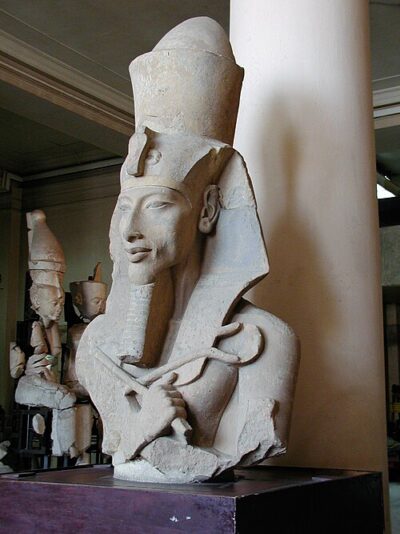
Akhenaten
Akhenaten was an Egyptian pharaoh in 18th Dynasty. Born 14th century BC, in Thebes. Died 1336 BC, in Amarna. Positions held include pharaoh (-1349–-1333).
Facts
32 facts · 0 confirmed by two sources · 4 cited · 28 from one source
Where this comes from
Papalocal keeps its own record. It started from these sources; what each one said is kept here as it was copied, so a change on their side never changes this page by itself. Tap one to read its version.
What Wikidata says · copied November 16, 2026 · revision 2565528103
- Described as
- Egyptian pharaoh in 18th Dynasty
- Other names
- Khuenaten, Ikhnaton, Amenhotep IV, Amenhotep mi padre, Akenaten, Akhnaten, Echnaton, Akhenaton, Amenophis IV
- Born
- 14th century BC
- Died
- 1336 BC
- Born in
- Thebes
- Died in
- Amarna
- Buried in
- Royal Tomb of Akhenaten
- Citizen of
- Ancient Egypt
- Occupation
- pharaoh · 1 reference
- Positions held
- pharaoh (-1349–-1333) · 1 reference
- Spouse
- Kiya; The Younger Lady · 1 reference; Tadukhipa · 1 reference; Nefertiti · 1 reference
- Children
- Meritaten Tasherit; Ankhesenpaaten Tasherit; Setepenre; Neferneferure; Neferneferuaten Tasherit; Ankhesenamun; Meketaten; Tutankhamun; Meritaten
- Father
- Amenhotep III
- Mother
- Tiye
- Siblings
- Sitamun; Beketaten; Iset; Nebetah; Henuttaneb; The Younger Lady; Smenkhkare; Thutmose; Kiya · 1 reference
- Wikipedias with a page
- 106
Wikidata item Q81794 (wikidata.org/wiki/Q81794), public domain (CC0). Copied November 16, 2026.
What Wikipedia says · copied November 16, 2026 · revision 1385500667
Akhenaten (pronounced ), also spelled Akhenaton, Echnaton, and Khuenaten (Ancient Egyptian: ꜣḫ-n-jtn ʾŪḫə-nə-yātəy, pronounced [ˈʔuːχəʔ nə ˈjaːtəj] , meaning 'Effective for the Aten'; c. 1373 BC - c. 1335 BC), was an ancient Egyptian pharaoh reigning c. 1353–1336 or 1351–1334 BC, the 10th ruler of the 18th Dynasty. Originally named Amenhotep IV (Ancient Egyptian: jmn-ḥtp, meaning "Amun is satisfied", Hellenized as Amenophis IV), in the fifth year of his reign he changed his name to "Akhenaten".
As pharaoh, Akhenaten is noted for abandoning the traditional, polytheistic ancient Egyptian religion, and introducing Atenism, or worship centered around Aten. The views of Egyptologists differ as to whether the religious policy was absolutely monotheistic, or whether it was monolatristic, syncretistic, or henotheistic. This culture shift away from traditional religion was reversed after his death. Akhenaten's monuments were dismantled and hidden, his statues were destroyed, and his name excluded from lists of rulers compiled by later pharaohs. Traditional religious practice was gradually restored, notably under his close successor Tutankhamun, who changed his name from Tutankhaten early in his reign. When, some dozen years later, rulers without clear rights of succession from the Eighteenth Dynasty founded a new dynasty, they discredited Akhenaten and his immediate successors and referred to him as "the enemy of Akhetaten", "the enemy" or "that criminal" in archival records.
Akhenaten was all but lost to history until the late 19th-century discovery of Amarna, or Akhetaten, the new capital city he built for the worship of Aten. Furthermore, in 1907 a mummy that could be Akhenaten's was unearthed from the tomb KV55 in the Valley of the Kings by Edward Ayrton. Genetic testing has determined that the man buried in KV55 was Tutankhamun's father, but its identification as Akhenaten has since been questioned.
Akhenaten's rediscovery and Flinders Petrie's early excavations at Amarna sparked great public interest in the pharaoh and his queen Nefertiti. He has been described as "enigmatic", "mysterious", "revolutionary", "the greatest idealist of the world", and "the first individual in history", but also as a "heretic", "fanatic", "possibly insane", and "mad". Public and scholarly fascination with Akhenaten comes from his connection with Tutankhamun, the unique style and high quality of the pictorial arts he patronized, and the religion he attempted to establish, foreshadowing monotheism.
From the Wikipedia article “Akhenaten” (en.wikipedia.org/wiki/Akhenaten), by its contributors, under CC BY-SA 4.0 (creativecommons.org/licenses/by-sa/4.0/). Copied November 16, 2026; not changed.
Confirmed Two sources agree. Cited One source, and it names where it got it. One source One source, without a reference of its own. Sources disagree The sources disagree. We show the best-supported value and keep theirs below.
