
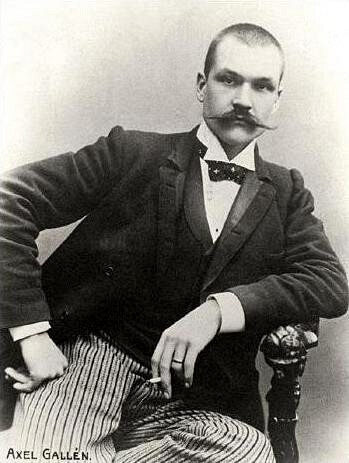
Akseli Gallen-Kallela
Akseli Gallen-Kallela was a Finnish painter. Born April 26, 1865, in Pori. Died March 7, 1931, in Stockholm. Known for The Artist's Mother, Lemminkäinen's Mother and The Defense of the Sampo. Educated at Académie Julian and Gymnasiet Svenska normallyceum. Awards include Knight of the Legion of Honour, Ducat Prize and Commander of the Order of the White Rose of Finland.
Facts
40 facts · 2 confirmed by two sources · 19 cited · 19 from one source
Where this comes from
Papalocal keeps its own record. It started from these sources; what each one said is kept here as it was copied, so a change on their side never changes this page by itself. Tap one to read its version.
What Wikidata says · copied November 16, 2026 · revision 2568198317
- Described as
- Finnish painter (1865-1931)
- Other names
- Axel Waldemar Gallén, Axel Gallén, Axel Gallén-Kallela, Akseli Valdemar Gallén-Kallela, Akseli Valdemar Gallen-Kallela, Akseli Kallela, Aksel' Gallén, Akseli Gallèn-Kallela, Akseli Gallén- Kallela, Akseli Valdemar Gallen- Kallela, Axel Waldemar Gallen, Axel Gallen
- Born
- April 26, 1865 · 12 references
- Died
- March 7, 1931 · 13 references
- Born in
- Pori · 2 references
- Died in
- Stockholm · 2 references
- Buried in
- Hietaniemi cemetery · 1 reference
- Cause of death
- pneumonia
- Name at birth
- Axel Waldemar Gallén · 1 reference
- Citizen of
- Finland (1917–) · 2 references; Grand Duchy of Finland (–1917)
- Occupation
- painter · 3 references; printmaker; illustrator · 1 reference; architect · 1 reference; designer · 2 references; exlibrist · 1 reference; draftsperson · 1 reference
- Education
- Académie Julian (1884–1889); Gymnasiet Svenska normallyceum (1876–1881); Academy of Fine Arts of Helsinki (1878–1884)
- Genre
- portrait; history painting · 1 reference; landscape painting · 1 reference; Impressionism · 1 reference; photography · 1 reference; work of art · 1 reference
- Known for
- The Artist's Mother; Lemminkäinen's Mother; The Defense of the Sampo
- Awards
- Knight of the Legion of Honour (1902) · 1 reference; Ducat Prize (1888); Commander of the Order of the White Rose of Finland (1919) · 1 reference; Commander First Class of the Order of the White Rose of Finland (1928) · 1 reference; Cross of Liberty, 3rd Class (1918) · 1 reference; Knight Grand Officer of the Order of Saint Olav (1923) · 1 reference
- Field
- painting · 1 reference
- Spouse
- Mary Gallen-Kallela
- Children
- Kirsti Gallen-Kallela; Jorma Gallen-Kallela
- Siblings
- Uno Gallén
- Lived in
- Kalela
- Wikipedias with a page
- 53
Wikidata item Q170068 (wikidata.org/wiki/Q170068), public domain (CC0). Copied November 16, 2026.
What Wikipedia says · copied November 16, 2026 · revision 1385525156
Akseli Gallen-Kallela (born Axel Waldemar Gallén; 26 April 1865 – 7 March 1931) was a Finnish painter and a leading figure of Finnish romantic nationalism around the turn of the 20th century. He is considered a pioneer of a distinctly Finnish national art, and his work is regarded as a very important aspect of Finnish national identity.
Gallen-Kallela began his career as a realist painter influenced by Jules Bastien-Lepage before turning, in the 1890s, towards symbolism and a stylised national-romantic idiom. He is best known for his depictions of the Kalevala, the Finnish national epic, including The Defense of the Sampo, Lemminkäinen's Mother and the Aino Triptych, as well as for his illustrations to the Kalevala and to Aleksis Kivi's novel Seven Brothers. He was also active as a graphic artist, designer and fresco painter, executing monumental works for the Finnish pavilion at the Paris World Fair of 1900 and the Jusélius Mausoleum in Pori. He finnicized his name from Gallén to Gallen-Kallela in 1907.
- Born, in its opening lines
- April 26, 1865
- Died, in its opening lines
- March 7, 1931
From the Wikipedia article “Akseli Gallen-Kallela” (en.wikipedia.org/wiki/Akseli_Gallen-Kallela), by its contributors, under CC BY-SA 4.0 (creativecommons.org/licenses/by-sa/4.0/). Copied November 16, 2026; not changed.
Confirmed Two sources agree. Cited One source, and it names where it got it. One source One source, without a reference of its own. Sources disagree The sources disagree. We show the best-supported value and keep theirs below.
