
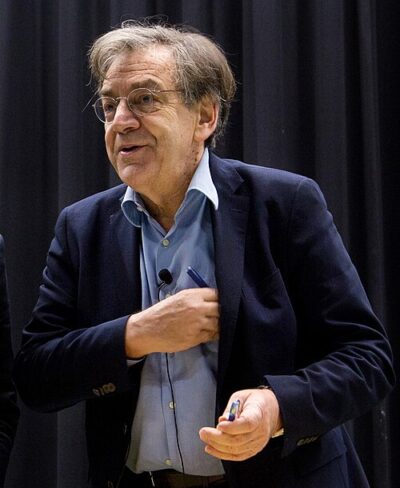
Alain Finkielkraut
Alain Finkielkraut is a French philosopher. Born June 30, 1949, in Paris. Positions held include Member of the Académie française (2014–). Known for Le Nouveau Désordre amoureux, The Unhappy Identity and La Seule Exactitude. Educated at École normale supérieure de Saint-Cloud and Lycée Henri-IV. Awards include Officer of the Legion of Honour, Prix Européen de l'Essai Charles Veillon and Prix de l'essai.
Facts
43 facts · 1 confirmed by two sources · 16 cited · 26 from one source
Where this comes from
Papalocal keeps its own record. It started from these sources; what each one said is kept here as it was copied, so a change on their side never changes this page by itself. Tap one to read its version.
What Wikidata says · copied November 16, 2026 · revision 2568213037
- Described as
- French philosopher (born 1949)
- Other names
- Alain Luc Finkielkraut, Finkielkraut
- Born
- June 30, 1949 · 4 references
- Born in
- Paris · 2 references
- Name at birth
- Alain Luc Finkielkraut
- Citizen of
- Poland (1949–1950); France (1950–) · 1 reference
- Occupation
- philosopher · 2 references; radio personality; writer · 1 reference; radio producer; non-fiction writer; opinion journalist · 1 reference; critic · 1 reference; literary scholar · 1 reference
- Positions held
- Member of the Académie française (2014–) · 1 reference
- Worked for
- France Culture (1985–); École polytechnique (1989–2014)
- Education
- École normale supérieure de Saint-Cloud (1969–); Lycée Henri-IV · 1 reference
- Member of
- Académie Française (2014–) · 1 reference
- Known for
- Le Nouveau Désordre amoureux; The Unhappy Identity; La Seule Exactitude
- Awards
- Officer of the Legion of Honour (2009); Prix Européen de l'Essai Charles Veillon (1984); Prix de l'essai (2010); honorary doctor of Tel Aviv University (2007); Knight of the Legion of Honour (1994) · 2 references; Prix Combourg-Chateaubriand (2014); “Today” Prize (1999) · 1 reference; Order of Danica Hrvatska · 1 reference; Vauban Prize (2014) · 1 reference; Prix Moron (1992) · 1 reference; Francine and Antoine Bernheim Award for Arts, Literature and Science (1986) · 1 reference
- Field
- history of ideas; modernity; education; political philosophy; religion; intellectual
- Spouse
- Sylvie Topaloff (1985–)
- Children
- Thomas Finkielkraut
- Father
- Daniel Finkielkraut · 1 reference
- Religion
- Judaism
- Wikipedias with a page
- 40
Wikidata item Q380443 (wikidata.org/wiki/Q380443), public domain (CC0). Copied November 16, 2026.
What Wikipedia says · copied November 16, 2026 · revision 1385799859
Alain Luc Finkielkraut (French: [alɛ̃ finkɛlkʁot]; Yiddish: [fɪŋkiːlˈkʁaʊ̯t]; born 30 June 1949) is a French essayist, radio producer, and public intellectual. Since 1986, he has been the host of Répliques, a talk show broadcast weekly on France Culture. He was elected a Fellow of the Académie Française in 2014.
- Born, in its opening lines
- June 30, 1949
From the Wikipedia article “Alain Finkielkraut” (en.wikipedia.org/wiki/Alain_Finkielkraut), by its contributors, under CC BY-SA 4.0 (creativecommons.org/licenses/by-sa/4.0/). Copied November 16, 2026; not changed.
Confirmed Two sources agree. Cited One source, and it names where it got it. One source One source, without a reference of its own. Sources disagree The sources disagree. We show the best-supported value and keep theirs below.
