
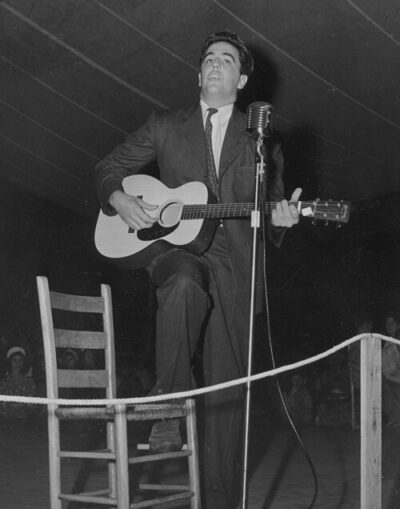
Alan Lomax
Alan Lomax was an American musicologist. Born January 31, 1915, in Austin. Died July 19, 2002, in Safety Harbor. Educated at Harvard University and Columbia University. Awards include Guggenheim Fellowship, National Medal of Arts and Grammy Trustees Award.
Facts
29 facts · 2 confirmed by two sources · 7 cited · 20 from one source
Where this comes from
Papalocal keeps its own record. It started from these sources; what each one said is kept here as it was copied, so a change on their side never changes this page by itself. Tap one to read its version.
What Wikidata says · copied November 15, 2026 · revision 2568194816
- Described as
- American musicologist (1915–2002)
- Born
- January 31, 1915 · 4 references
- Died
- July 19, 2002 · 7 references
- Born in
- Austin · 1 reference
- Died in
- Safety Harbor · 1 reference
- Citizen of
- United States · 1 reference
- Occupation
- anthropologist; musicologist; historian; ethnomusicologist; music historian; photographer; music critic; journalist
- Education
- Harvard University; Columbia University; University of Texas at Austin; Choate Rosemary Hall; St. Mark's School of Texas · 1 reference
- Member of
- Phi Beta Kappa Society
- Awards
- Guggenheim Fellowship (1946) · 1 reference; National Medal of Arts; Grammy Trustees Award (2003); Library of Congress Living Legend (2000–) · 1 reference; National Book Critics Circle Award in Nonfiction (1993) · 1 reference
- Spouse
- Elizabeth Lyttleton Sturz · 1 reference
- Children
- Anna Lomax Wood
- Father
- John Lomax · 1 reference
- Siblings
- Bess Lomax Hawes; John Lomax Jr.
- Wikipedias with a page
- 33
Wikidata item Q558104 (wikidata.org/wiki/Q558104), public domain (CC0). Copied November 15, 2026.
What Wikipedia says · copied November 15, 2026 · revision 1384160322
Alan Lomax (; January 31, 1915 – July 19, 2002) was an American ethnomusicologist, best known for his numerous field recordings of folk music during the 20th century. He was a musician, folklorist, archivist, writer, scholar, political activist, oral historian, filmmaker and son of folklorist John Lomax. Lomax produced recordings, concerts, and radio shows in the U.S. and in England which played an important role in preserving folk music traditions in both countries and helped start both the American and British folk revivals of the 1940s, 1950s, and especially the early 1960s. Lomax recorded thousands of songs and interviews for the Archive of American Folk Song, of which he was the director, at the Library of Congress on aluminum and acetate discs.
After 1942, when Congress terminated the Library of Congress's funding for folk song collecting, Lomax continued to collect independently in Britain, Ireland, Italy, Spain, Basque Country, the United States, and the Caribbean, recording and assembling a collection of American and international culture. In March 2004, the material captured and produced without Library of Congress funding was acquired by the Library, which "brings the entire seventy years of Alan Lomax's work together under one roof at the Library of Congress, where it has found a permanent home." With the start of the Cold War, Lomax continued to advocate for a public role for folklore, even as academic folklorists turned inward. He devoted much of the latter part of his life to advocating what he called Cultural Equity, which he sought to put on a solid theoretical foundation through to his Cantometrics research (which included a prototype Cantometrics-based educational program, the Global Jukebox). In the 1970s and 1980s, Lomax advised the Smithsonian Institution's Folklife Festival and produced a series of films about folk music, American Patchwork, which aired on PBS in 1991. In his late 70s, Lomax completed the long-deferred memoir The Land Where the Blues Began (1993), linking the birth of the blues to debt peonage, segregation, and forced labor in the American South.
Lomax's greatest legacy is in preserving and publishing recordings of musicians in many folk and blues traditions around the U.S. and Europe. Artists Lomax is credited with discovering and bringing to a wider audience include blues guitarist Robert Johnson, protest singer Woody Guthrie, folk artist Pete Seeger, country musician Burl Ives, Scottish Gaelic singer Flora MacNeil, and country blues singers Lead Belly and Muddy Waters, among many others. "Alan scraped by the whole time, and left with no money," said Don Fleming, director of Lomax's Association for Culture Equity. "He did it out of the passion he had for it, and found ways to fund projects that were closest to his heart".
- Born, in its opening lines
- January 31, 1915
- Died, in its opening lines
- July 19, 2002
From the Wikipedia article “Alan Lomax” (en.wikipedia.org/wiki/Alan_Lomax), by its contributors, under CC BY-SA 4.0 (creativecommons.org/licenses/by-sa/4.0/). Copied November 15, 2026; not changed.
Confirmed Two sources agree. Cited One source, and it names where it got it. One source One source, without a reference of its own. Sources disagree The sources disagree. We show the best-supported value and keep theirs below.
