
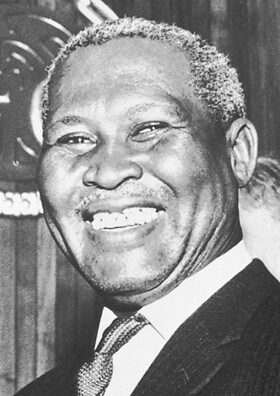
Albert John Mvumbi Luthuli
Albert John Mvumbi Luthuli was a South African politician. Born 1898, in Bulawayo. Died July 21, 1967, in KwaDukuza. Known for Let My People Go. Educated at University of Glasgow and Adams College. Awards include Nobel Peace Prize, United Nations Prize in the Field of Human Rights and Order of Mapungubwe in Platinum.
Facts
21 facts · 2 confirmed by two sources · 5 cited · 14 from one source
Where this comes from
Papalocal keeps its own record. It started from these sources; what each one said is kept here as it was copied, so a change on their side never changes this page by itself. Tap one to read its version.
What Wikidata says · copied November 16, 2026 · revision 2568438596
- Described as
- South African politician (1898–1967)
- Other names
- Albert John Mvumbi Lutuli, Albert John Lutuli, Albert Luthuli, Mvumbi Lutuli, Mvumbi Luthuli, Albert John Luthuli
- Born
- 1898 · 11 references
- Died
- July 21, 1967 · 6 references
- Born in
- Bulawayo · 3 references
- Died in
- KwaDukuza
- Cause of death
- railway accident by collision
- Name at birth
- Albert John Mvumbi Luthuli
- Citizen of
- South Africa
- Occupation
- politician · 3 references; autobiographer; teacher · 1 reference; anti-apartheid activist
- Political party
- African National Congress
- Worked for
- University of Glasgow
- Education
- University of Glasgow · 1 reference; Adams College
- Known for
- Let My People Go
- Awards
- Nobel Peace Prize (1960) · 2 references; United Nations Prize in the Field of Human Rights (1968) · 1 reference; Order of Mapungubwe in Platinum (2012) · 1 reference
- Field
- teacher
- Spouse
- Nokukhanya Bhengu · 1 reference
- Wikipedias with a page
- 63
Wikidata item Q212955 (wikidata.org/wiki/Q212955), public domain (CC0). Copied November 16, 2026.
What Wikipedia says · copied November 16, 2026 · revision 1378202591
Albert John Luthuli (c. 1898 – 21 July 1967) was a South African anti-apartheid activist, traditional leader, and politician who served as the President-General of the African National Congress from 1952 until his assassination in 1967.
Luthuli was born to a Zulu family in 1898 at a Seventh-day Adventist mission in Bulawayo, Rhodesia (now Zimbabwe). In 1908 he moved to Groutville, where his parents and grandparents had lived, to attend school under the care of his uncle. After graduating from high school with a teaching degree, Luthuli became principal of a small school in Natal where he was the sole teacher. He accepted a government bursary to study for the Higher Teacher's Diploma at Adams College. After the completion of his studies in 1922, he accepted a teaching position at Adams College where he was one of the first African teachers. In 1928, he became the secretary of the Natal Native Teachers' Association, then its president in 1933.
Luthuli entered South African politics and the anti-apartheid movement in 1935, when he was elected chief of the Umvoti River Reserve in Groutville. As chief, he was exposed to the injustices facing many Africans due to the South African government's increasingly segregationist policies. This segregation would later evolve into apartheid, a form of institutionalized racial segregation, following the National Party's election victory in 1948. Luthuli joined the African National Congress (ANC) in 1944 and was elected the provincial president of the Natal branch in 1951. A year later in 1952, Luthuli led the Defiance Campaign to protest the pass laws and other laws of apartheid. As a result, the government removed him from his chief position as he refused to choose between being a member of the ANC or a chief at Groutville. In the same year, he was elected President-General of the ANC. After the Sharpeville massacre, where sixty-nine Africans were killed, leaders within the ANC such as Nelson Mandela believed the organisation should take up armed resistance against the government. Luthuli was initially against the use of violence. He later gradually came to accept it, but stayed committed to nonviolence on a personal level. Following four banning orders, the imprisonment and exile of his political allies, and the banning of the ANC, Luthuli's power as President-General gradually waned. The subsequent creation of uMkhonto we Sizwe, the ANC's paramilitary wing, marked the anti-apartheid movement's shift from nonviolence to an armed struggle.
Inspired by his Christian faith and the nonviolent methods used by Gandhi, Luthuli was praised for his dedication to nonviolent resistance against apartheid as well as his vision of a non-racial South African society. In 1961, Luthuli was awarded the 1960 Nobel Peace Prize for his role in leading the nonviolent anti-apartheid movement. Luthuli's supporters brand him as a global icon of peace similar to Gandhi and Martin Luther King Jr, the latter of whom was a follower and admirer of Luthuli. He formed multi-racial alliances with the South African Indian Congress and the white Congress of Democrats, frequently drawing a backlash from Africanists in the ANC. The Africanist bloc believed that Africans should not ally themselves with other races, since Africans were the most disadvantaged race under apartheid. This schism led to the creation of the Pan-Africanist Congress.
- Born, in its opening lines
- c. 1898
- Died, in its opening lines
- July 21, 1967
From the Wikipedia article “Albert Luthuli” (en.wikipedia.org/wiki/Albert_Luthuli), by its contributors, under CC BY-SA 4.0 (creativecommons.org/licenses/by-sa/4.0/). Copied November 16, 2026; not changed.
Confirmed Two sources agree. Cited One source, and it names where it got it. One source One source, without a reference of its own. Sources disagree The sources disagree. We show the best-supported value and keep theirs below.
