
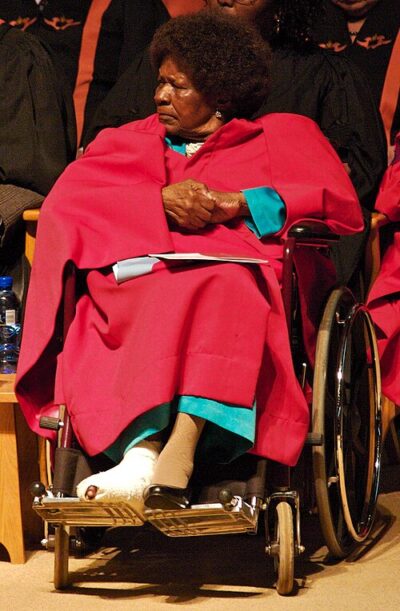
Albertina Nontsikelelo Sisulu
Albertina Nontsikelelo Sisulu was a South African anti–apartheid activist. Born October 21, 1918, in Tsomo. Died June 2, 2011, in Johannesburg. Awards include Order for Meritorious Service.
Facts
15 facts · 2 confirmed by two sources · 2 cited · 10 from one source · 1 where the sources disagree
What’s different
- Died in: we show Johannesburg (Sources disagree). Wikidata also lists South Africa
Where this comes from
Papalocal keeps its own record. It started from these sources; what each one said is kept here as it was copied, so a change on their side never changes this page by itself. Tap one to read its version.
What Wikidata says · copied November 16, 2026 · revision 2566316724
- Described as
- South African anti–apartheid activist (1918-2011)
- Other names
- Nontsikelelo Albertina Sisulu, Albertina Sisulu
- Born
- October 21, 1918 · 2 references
- Died
- June 2, 2011 · 3 references
- Born in
- Tsomo · 1 reference
- Died in
- Johannesburg · 1 reference; South Africa
- Name at birth
- Nontsikelelo Thethiwe
- Citizen of
- South Africa
- Occupation
- midwife; politician; anti-apartheid activist
- Political party
- African National Congress
- Awards
- Order for Meritorious Service (2003)
- Spouse
- Walter Sisulu (1944–2003) · 1 reference
- Children
- Max Sisulu; Lindiwe Sisulu; Zwelakhe Sisulu
- Wikipedias with a page
- 31
Wikidata item Q467744 (wikidata.org/wiki/Q467744), public domain (CC0). Copied November 16, 2026.
What Wikipedia says · copied November 16, 2026 · revision 1365459190
Albertina Sisulu (née Nontsikelelo Thethiwe; 21 October 1918 – 2 June 2011) was a South African anti-apartheid activist. A member of the African National Congress (ANC), she was the founding co-president of the United Democratic Front. In South Africa, where she was affectionately known as Ma Sisulu, she is often called a mother of the nation.
Born in rural Transkei, Sisulu moved to Johannesburg in 1940 and was a nurse by profession. She entered politics through her marriage to Walter Sisulu and became increasingly engaged in activism after his imprisonment in the Rivonia Trial. In the 1980s she emerged as a community leader in her hometown of Soweto, assuming a prominent role in the establishment of the UDF and the revival of the Federation of South African Women.
Between 1964 and 1989, she was subject to a near-continuous string of banning orders. In addition to intermittent detention without trial, she was subject to criminal charges on three occasions: she was acquitted of violating pass laws in 1958, convicted of violating the Suppression of Communism Act in 1984, and acquitted of violating the Internal Security Act in the 1985 Pietermaritzburg Treason Trial.
After the end of apartheid, Sisulu represented the ANC in the first democratic Parliament before she retired from politics in 1999. She was also the deputy president of the ANC Women's League from 1991 to 1993 and a member of the ANC National Executive Committee from 1991 to 1994.
- Born, in its opening lines
- October 21, 1918
- Died, in its opening lines
- June 2, 2011
From the Wikipedia article “Albertina Sisulu” (en.wikipedia.org/wiki/Albertina_Sisulu), by its contributors, under CC BY-SA 4.0 (creativecommons.org/licenses/by-sa/4.0/). Copied November 16, 2026; not changed.
Confirmed Two sources agree. Cited One source, and it names where it got it. One source One source, without a reference of its own. Sources disagree The sources disagree. We show the best-supported value and keep theirs below.
