
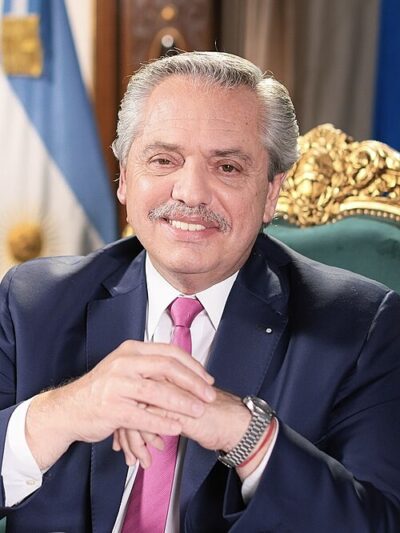
Alberto Fernández
Alberto Fernández is a president of Argentina from 2019 to 2023. Born April 2, 1959, in Buenos Aires. Positions held include legislator of the City of Buenos Aires (2000–2003), Chief of the Cabinet of Ministers of Argentina (2003–2008) and President of Argentina (2019–2023). Educated at University of Buenos Aires. Awards include Grand Collar of the Order of the Southern Cross, Order of the Liberator General San Martín and Order of May.
Facts
25 facts · 1 confirmed by two sources · 10 cited · 14 from one source
Where this comes from
Papalocal keeps its own record. It started from these sources; what each one said is kept here as it was copied, so a change on their side never changes this page by itself. Tap one to read its version.
What Wikidata says · copied November 16, 2026 · revision 2561593702
- Described as
- president of Argentina from 2019 to 2023
- Other names
- Alberto Fernandez, Alberto Ángel Fernández
- Born
- April 2, 1959 · 1 reference
- Born in
- Buenos Aires · 1 reference
- Name at birth
- Alberto Ángel Fernández
- Citizen of
- Argentina
- Occupation
- politician · 1 reference; lawyer; university teacher · 1 reference; jurist · 1 reference
- Positions held
- legislator of the City of Buenos Aires (2000–2003) · 1 reference; Chief of the Cabinet of Ministers of Argentina (2003–2008); President of Argentina (2019–2023) · 1 reference; Mercosur Pro Tempore Presidency (2020–2021) · 1 reference; Pro tempore presidency of the Community of Latin American and Caribbean States (2022–2023)
- Political party
- Justicialist Party (2 times) (1983–2024) · 1 reference; Renewal Front (2013–2017)
- Worked for
- University of Buenos Aires
- Education
- University of Buenos Aires (1983) · 1 reference
- Member of
- Puebla Group
- Awards
- Grand Collar of the Order of the Southern Cross (2023) · 1 reference; Order of the Liberator General San Martín · 1 reference; Order of May · 1 reference; Order of the Badge of Honour · 1 reference
- Children
- Tani Fernández Luchetti
- Lived in
- Quinta presidencial de Olivos (2019–2023); Puerto Madero (2023–) · 1 reference
- Wikipedias with a page
- 78
Wikidata item Q2642828 (wikidata.org/wiki/Q2642828), public domain (CC0). Copied November 16, 2026.
What Wikipedia says · copied November 16, 2026 · revision 1385505994
Alberto Ángel Fernández (Latin American Spanish: [alˈβeɾto ˈaŋxel feɾˈnandes] ; born 2 April 1959) is an Argentine politician, lawyer, and academic who served as President of Argentina from 2019 to 2023. He was also the Chief of the Cabinet of Ministers from 2003 to 2008. His tenure as Cabinet Chief remains the longest since the post was created in 1994.
Born in Buenos Aires, Fernández attended the University of Buenos Aires, where he earned his law degree at age 24, and later became a professor of criminal law. Ideologically a Peronist, entered public service as an adviser to Deliberative Council of Buenos Aires and the Argentine Chamber of Deputies. In 2003, he was appointed Chief of the Cabinet of Ministers, serving during the entirety of the presidency of Néstor Kirchner, and the early months of the presidency of Cristina Fernández de Kirchner.
A member of the Justicialist Party, a Peronist party, Fernández was the party's candidate for the 2019 presidential election under the leftist Frente de Todos alliance and defeated incumbent president Mauricio Macri with 48% of the vote. His political position has been described as centrist. The first two years of his presidency was limited by the COVID-19 pandemic in Argentina, during which he imposed strict lockdown measures to suppress the spread of the disease, and a debt crisis inherited from his predecessor. While the economy recovered in 2021–22, inflation rose to 100% (the highest since 1991). His approval ratings were generally low throughout his presidency, with only a few measurements of majority approval, and disapproval ratings mostly ranging from 60% to 80%.
According to British newspaper The Economist, Fernández was considered "a president without a plan", and his presidency to be a "weak administration". In April 2023, Fernández announced that he decided to not seek reelection to the presidency in the 2023 presidential election. He was succeeded by Javier Milei on 10 December 2023. Leaving office with a disapproval rate of around 80%, Fernández's presidency is widely regarded by critics and historians as one of the worst in Argentine history.
- Born, in its opening lines
- April 2, 1959
From the Wikipedia article “Alberto Fernández” (en.wikipedia.org/wiki/Alberto_Fernández), by its contributors, under CC BY-SA 4.0 (creativecommons.org/licenses/by-sa/4.0/). Copied November 16, 2026; not changed.
Confirmed Two sources agree. Cited One source, and it names where it got it. One source One source, without a reference of its own. Sources disagree The sources disagree. We show the best-supported value and keep theirs below.
