
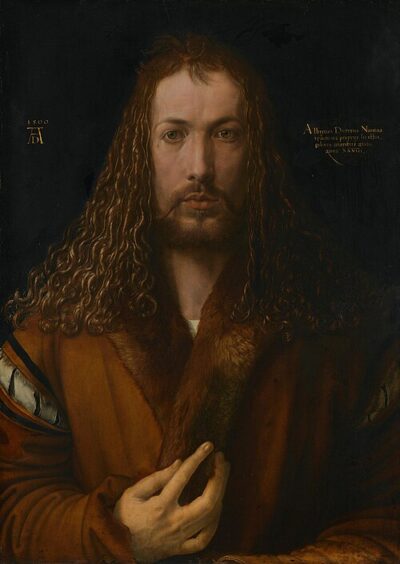
Albrecht Dürer
Albrecht Dürer was a German painter, printmaker, mathematician, and theorist. Born May 21, 1471, in Nuremberg. Died April 6, 1528, in Nuremberg. Known for Melencolia I, Adoration of the Magi and Self-Portrait with Fur-Trimmed Robe.
Facts
39 facts · 2 confirmed by two sources · 21 cited · 16 from one source
Where this comes from
Papalocal keeps its own record. It started from these sources; what each one said is kept here as it was copied, so a change on their side never changes this page by itself. Tap one to read its version.
What Wikidata says · copied November 16, 2026 · revision 2568488263
- Described as
- German painter, printmaker, mathematician, and theorist (1471–1528)
- Other names
- Alberdure, Aldrecht Durer, Alverto Dureño, Albert van Dürer, Alberto Dura, Alberto Duro, Albrecht DurerDura, Albert Dúr, Alberto Duredo, Albert Duerer, Alberto Durero, Alberto Duri
- Born
- May 21, 1471 · 16 references
- Died
- April 6, 1528 · 15 references
- Born in
- Nuremberg · 9 references
- Died in
- Nuremberg · 8 references
- Buried in
- Johannisfriedhof (Nürnberg)
- Citizen of
- Duchy of Bavaria · 1 reference
- Occupation
- painter · 8 references; printmaker · 3 references; mathematician · 1 reference; illuminator · 1 reference; copper engraver · 4 references; art theorist · 3 references; draftsperson · 3 references; illustrator · 2 references
- Genre
- portrait; religious painting · 1 reference; allegory · 1 reference; history painting · 1 reference; mythological painting · 1 reference; genre painting · 1 reference
- Known for
- Melencolia I; Adoration of the Magi; Self-Portrait with Fur-Trimmed Robe; Adam and Eve; Feast of the Rosary; Praying Hands; Knight, Death, and the Devil; St. Jerome in His Study; The Rhinoceros; The Four Apostles
- Field
- painting
- Spouse
- Agnes Dürer (1494–) · 1 reference
- Father
- Albrecht Dürer the Elder · 1 reference
- Mother
- Barbara Dürer · 1 reference
- Siblings
- Hans Dürer the Younger · 1 reference; Endres Dürer · 1 reference
- Religion
- Lutheranism
- Lived in
- Venice (1505–1507) · 1 reference; Nuremberg (1507–1528)
- Wikipedias with a page
- 189
Wikidata item Q5580 (wikidata.org/wiki/Q5580), public domain (CC0). Copied November 16, 2026.
What Wikipedia says · copied November 16, 2026 · revision 1384885104
Albrecht Dürer ( DURE-ər, German: [ˈalbʁɛçt ˈdyːʁɐ]; 21 May 1471 – 6 April 1528), sometimes spelled in English as Durer or Duerer, was a German painter, printmaker, and theorist of the German Renaissance. Born in Nuremberg, Dürer established his reputation and influence across Europe in his twenties due to his high-quality woodcut prints. He was in contact with the major Italian artists of his time, including Raphael, Giovanni Bellini, and Leonardo da Vinci, and from 1512 onward was patronized by Emperor Maximilian I.
Dürer's vast body of work includes engravings, his preferred technique in his later prints, altarpieces, portraits and self-portraits, watercolours and books. The woodcuts series are stylistically more Gothic than the rest of his work, but revolutionised the potential of that medium, while his extraordinary handling of the burin expanded especially the tonal range of his engravings.
Dürer's introduction of classical motifs and of the nude into Northern art, through his knowledge of Italian artists and German humanists, has secured his reputation as one of the most important figures of the Northern Renaissance. This is reinforced by his theoretical treatises, which involve principles of mathematics for linear perspective and body proportions.
- Born, in its opening lines
- May 21, 1471
- Died, in its opening lines
- April 6, 1528
From the Wikipedia article “Albrecht Dürer” (en.wikipedia.org/wiki/Albrecht_Dürer), by its contributors, under CC BY-SA 4.0 (creativecommons.org/licenses/by-sa/4.0/). Copied November 16, 2026; not changed.
Confirmed Two sources agree. Cited One source, and it names where it got it. One source One source, without a reference of its own. Sources disagree The sources disagree. We show the best-supported value and keep theirs below.
