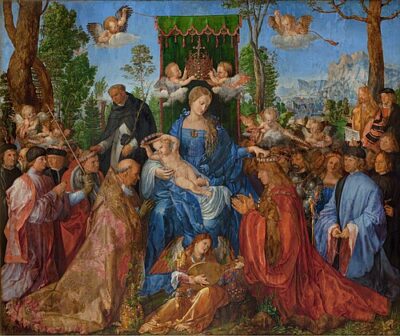
Feast of the Rosary
Feast of the Rosary is a painting by Albrecht Dürer. It came out in 1506.
- Came out
- 1506
- Created by
- Albrecht Dürer
- Genre
- religious art
All 8 facts, and where they come from
Facts
8 facts · 0 confirmed by two sources · 4 cited · 4 from one source
Where this comes from
Papalocal keeps its own record. It started from these sources; what each one said is kept here as it was copied, so a change on their side never changes this page by itself. Tap one to read its version.
What Wikidata says · copied November 17, 2026 · revision 2569728466
- Described as
- painting by Albrecht Dürer
- Other names
- Das Rosenkranzfest, feast of the rose garlands
- What it is
- altarpiece; painting
- Created by
- Albrecht Dürer · 1 reference
- Genre
- religious art · 1 reference
- Followed by
- The Feast of the Rose Garlands
- Came out
- 1506 · 2 references
- Owned by
- San Bartolomeo (1506–); Emperor Rudolf II (1606–) · 1 reference
- Wikipedias with a page
- 19
Wikidata item Q1170194 (wikidata.org/wiki/Q1170194), public domain (CC0). Copied 2026-11-17.
What Wikipedia says · copied November 17, 2026 · revision 1383368061
The Feast of the Rosary (German: Rosenkranzfest) is a 1506 oil painting by Albrecht Dürer, now in the National Gallery, Prague, Czech Republic. According to Czech art historian Jaroslav Pešina, it is "probably the most superb painting that a German master has ever created." The work also relates to a series of artworks commissioned by Maximilian I, his Burgundian subjects or figures close to his family to commemorate the Duchess Mary of Burgundy, Maximilian's first wife and to provide the focus for a cult-like phenomenon that associated her with her name-saint, the Virgin Mary.
From the Wikipedia article “Feast of the Rosary” (en.wikipedia.org/wiki/Feast_of_the_Rosary), by its contributors, under CC BY-SA 4.0 (creativecommons.org/licenses/by-sa/4.0/). Copied 2026-11-17; not changed.
Confirmed Two sources agree. Cited One source, and it names where it got it. One source One source, without a reference of its own. Sources disagree The sources disagree. We show the best-supported value and keep theirs below.
Picture: Albrecht Dürer, via Wikimedia Commons · Public domain