
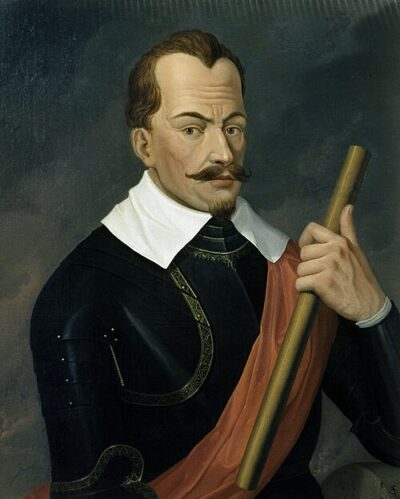
Albrecht von Wallenstein
Albrecht von Wallenstein was a Bohemian military leader and statesman who fought on the Catholic side during the Thirty Years' War. Born September 24, 1583, in Heřmanice. Died February 25, 1634, in Cheb. Positions held include generalissimo. Educated at University of Altdorf and Palacký University Olomouc. Awards include Order of the Golden Fleece.
Facts
24 facts · 2 confirmed by two sources · 10 cited · 12 from one source
What’s different
- Born: we show September 24, 1583 (Confirmed). Wikidata also lists September 14, 1583
Where this comes from
Papalocal keeps its own record. It started from these sources; what each one said is kept here as it was copied, so a change on their side never changes this page by itself. Tap one to read its version.
What Wikidata says · copied November 16, 2026 · revision 2568488918
- Described as
- Bohemian military leader and statesman who fought on the Catholic side during the Thirty Years' War (1583-1634)
- Other names
- Wallenstein, Albrecht z Valdštejna, Albrecht von Waldstein, Albrecht Wenzel Eusebius von Wallenstein
- Born
- September 24, 1583 · 2 references; September 14, 1583 · 1 reference
- Died
- February 25, 1634 · 6 references
- Born in
- Heřmanice · 2 references
- Died in
- Cheb · 2 references
- Buried in
- Valdice Charterhouse (1636–1785); Chapel of St Anne (1785–)
- Citizen of
- Kingdom of Bohemia
- Occupation
- politician · 2 references; military officer; military leader · 3 references
- Positions held
- generalissimo
- Education
- University of Altdorf; Palacký University Olomouc
- Awards
- Order of the Golden Fleece
- Field
- military affairs · 2 references; politics · 1 reference
- Spouse
- Anna Lukretia Nekesch von Landeck (1609–) · 1 reference; Elisabeth Harrach (1623–)
- Children
- Marie Alžběta z Valdštejna
- Father
- Wilhelm Waldstein · 1 reference
- Mother
- Margareta, Freiin Smirziczky von Smirzicz · 1 reference
- Siblings
- Kateřina Anna z Valdštejna · 1 reference
- Military branch
- Imperial Army
- Military rank
- generalissimo · 1 reference
- Wikipedias with a page
- 53
Wikidata item Q153545 (wikidata.org/wiki/Q153545), public domain (CC0). Copied November 16, 2026.
What Wikipedia says · copied November 16, 2026 · revision 1385457652
Albrecht Wenzel Eusebius von Wallenstein, Duke of Friedland (; 24 September 1583 – 25 February 1634), also von Waldstein (Czech: Albrecht Václav Eusebius z Valdštejna), was a Bohemian military leader, statesman and a major figure of the Thirty Years' War, fighting on the Catholic side as supreme commander of the armies of Holy Roman Emperor Ferdinand II. His successful martial career made him one of the richest and most influential men in the Holy Roman Empire by the time of his death. He is considered one of the most important military leaders produced by the early modern period.
Wallenstein was born in the Kingdom of Bohemia into a poor Czech Protestant noble family, affiliated with the Utraquist Hussites. He acquired a multilingual university education across Europe and converted to Catholicism in 1606. A marriage in 1609 to the wealthy widow of a Bohemian landowner gave him access to considerable estates and wealth after her death at an early age in 1614. Three years later, Wallenstein embarked on a career as a mercenary by raising forces for the Holy Roman Emperor in the Uskok War against the Republic of Venice.
Wallenstein fought for the Catholics in the Protestant Bohemian Revolt of 1618 and was awarded estates confiscated from the rebels after their defeat at White Mountain in 1620. A series of military victories against the Protestants raised Wallenstein's reputation in the imperial court and in 1625 he raised a large army of 50,000 men to further the Imperial cause. A year later, he administered a crushing defeat to the Protestants at Dessau Bridge. For his successes, Wallenstein became an imperial count palatine and made himself ruler of the lands of the Duchy of Friedland in northern Bohemia.
An imperial generalissimo by land, and Admiral of the Baltic Sea from April 1628, Wallenstein found himself released from service in 1630 after Ferdinand grew wary of his ambition. Several Protestant victories over Catholic armies induced Ferdinand to recall Wallenstein, who then defeated the Swedish king Gustavus Adolphus at Alte Veste. The Swedish king was later killed at the Battle of Lützen.
Wallenstein realised the war could last decades and, during the summer of 1633, arranged a series of armistices to negotiate peace. These proved to be his undoing as plotters accused him of treachery. Dissatisfied with the Emperor's treatment of him, Wallenstein considered allying with the Protestants. However, he was assassinated at Eger in Bohemia by one of the army's officials, with the emperor's approval.
- Born, in its opening lines
- September 24, 1583
- Died, in its opening lines
- February 25, 1634
From the Wikipedia article “Albrecht von Wallenstein” (en.wikipedia.org/wiki/Albrecht_von_Wallenstein), by its contributors, under CC BY-SA 4.0 (creativecommons.org/licenses/by-sa/4.0/). Copied November 16, 2026; not changed.
Confirmed Two sources agree. Cited One source, and it names where it got it. One source One source, without a reference of its own. Sources disagree The sources disagree. We show the best-supported value and keep theirs below.
