
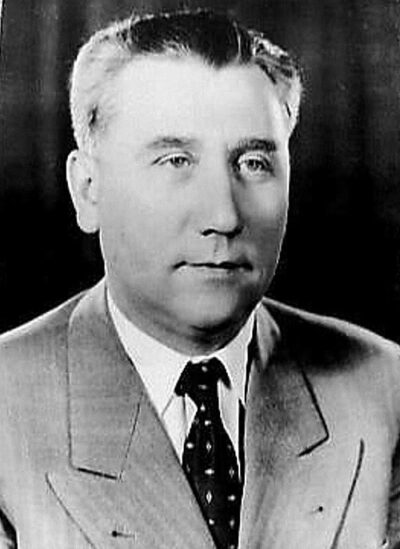
Aleksandar Ranković
Aleksandar Ranković was a Yugoslav politician. Born November 28, 1909, in Draževac. Died August 19, 1983, in Dubrovnik. Positions held include Vice President of Yugoslavia (1963–1966), Deputy Prime Minister of Yugoslavia (1949–1963) and Minister of the Interior of Yugoslavia (1946–1953). Awards include People's Hero of Yugoslavia, Order of the Hero of Socialist Labour and Order of Suvorov, 1st class.
Facts
27 facts · 2 confirmed by two sources · 2 cited · 23 from one source
What’s different
- Died: we show August 19, 1983 (Confirmed). Wikidata also lists August 20, 1983
Where this comes from
Papalocal keeps its own record. It started from these sources; what each one said is kept here as it was copied, so a change on their side never changes this page by itself. Tap one to read its version.
What Wikidata says · copied November 16, 2026 · revision 2562752807
- Described as
- Yugoslav politician (1909-1983)
- Other names
- Aleksandar Rankovic
- Born
- November 28, 1909 · 4 references
- Died
- August 20, 1983; August 19, 1983 · 1 reference
- Born in
- Draževac
- Died in
- Dubrovnik · 1 reference
- Buried in
- Belgrade New Cemetery
- Citizen of
- Yugoslavia
- Occupation
- politician · 1 reference; political commissar
- Positions held
- Vice President of Yugoslavia (1963–1966); Deputy Prime Minister of Yugoslavia (1949–1963); Minister of the Interior of Yugoslavia (1946–1953)
- Political party
- League of Communists of Yugoslavia
- Awards
- People's Hero of Yugoslavia (1945); Order of the Hero of Socialist Labour (1954); Order of Suvorov, 1st class; Order of Kutuzov, 1st class; Order "For Merit to the People"; Order of Brotherhood and Unity; Order of Bravery; Order of the Partisan Star; Order of the People's Liberation; Order of the People's Hero
- Spouse
- Anđa Ranković (1935–1942); Slavka Ranković (1946–1983)
- Military branch
- army; counterintelligence
- Military rank
- colonel general
- Wikipedias with a page
- 34
Wikidata item Q164756 (wikidata.org/wiki/Q164756), public domain (CC0). Copied November 16, 2026.
What Wikipedia says · copied November 16, 2026 · revision 1346674743
Aleksandar Ranković (nom de guerre Marko, nicknamed Leka; Serbian Cyrillic: Александар Ранковић Лека; 28 November 1909 – 19 August 1983) was a Serbian and Yugoslav communist politician, considered to be the third most powerful man in Yugoslavia after Josip Broz Tito and Edvard Kardelj. Ranković was a proponent of a centralized Yugoslavia and opposed efforts that promoted decentralization that he deemed to be against the interests of the Serbian people; he ensured Serbs had a strong presence in Serbia's Socialist Autonomous Province of Kosovo's nomenklatura. Ranković cautioned against separatist forces in Kosovo who were commonly suspected of pursuing seditious activities.
The popularity of Ranković in Serbia became apparent at his funeral in 1983, which large numbers of people attended. Many considered Ranković a Serbian "national" leader. Ranković's policies have been perceived as the basis of the policies of Slobodan Milošević.
- Born, in its opening lines
- November 28, 1909
- Died, in its opening lines
- August 19, 1983
From the Wikipedia article “Aleksandar Ranković” (en.wikipedia.org/wiki/Aleksandar_Ranković), by its contributors, under CC BY-SA 4.0 (creativecommons.org/licenses/by-sa/4.0/). Copied November 16, 2026; not changed.
Confirmed Two sources agree. Cited One source, and it names where it got it. One source One source, without a reference of its own. Sources disagree The sources disagree. We show the best-supported value and keep theirs below.
