
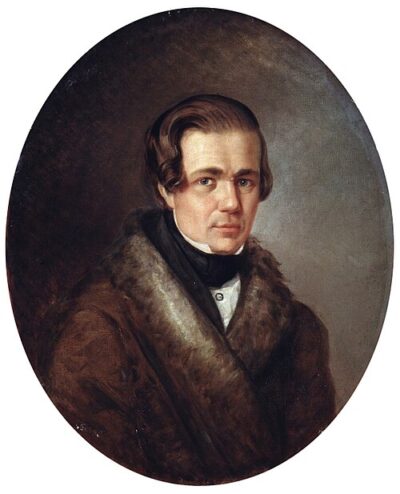
Aleksey Koltsov
Aleksey Koltsov was a Russian poet. Born October 3, 1809, in Voronezh. Died October 29, 1842, in Voronezh.
Facts
10 facts · 1 confirmed by two sources · 4 cited · 4 from one source · 1 where the sources disagree
What’s different
- Born: we show October 3, 1809 (Sources disagree). Wikipedia says October 15, 1809
Where this comes from
Papalocal keeps its own record. It started from these sources; what each one said is kept here as it was copied, so a change on their side never changes this page by itself. Tap one to read its version.
What Wikidata says · copied November 16, 2026 · revision 2558345045
- Described as
- Russian poet (1809–1842)
- Other names
- Aleksey Vasilievich Koltsov
- Born
- October 3, 1809 · 3 references
- Died
- October 29, 1842 · 2 references
- Born in
- Voronezh · 6 references
- Died in
- Voronezh · 5 references
- Cause of death
- tuberculosis
- Citizen of
- Russian Empire
- Occupation
- poet · 1 reference; writer · 1 reference; businessperson · 1 reference
- Genre
- poetry
- Wikipedias with a page
- 39
Wikidata item Q444969 (wikidata.org/wiki/Q444969), public domain (CC0). Copied November 16, 2026.
What Wikipedia says · copied November 16, 2026 · revision 1366945275
Aleksey Vasilievich Koltsov (Russian: Алексе́й Васи́льевич Кольцо́в; October 15, 1809 – October 29, 1842) was a Russian poet who has been called a Russian Burns. His poems, frequently placed in the mouth of women, stylize peasant-life songs and idealize agricultural labour. Koltsov earnestly collected Russian folklore which strongly influenced his poetry. He celebrated simple peasants, their work and their lives. Many of his poems were put to music by such composers as Dargomyzhsky, Mussorgsky, and Rimsky-Korsakov.
- Born, in its opening lines
- October 15, 1809
- Died, in its opening lines
- October 29, 1842
From the Wikipedia article “Aleksey Koltsov” (en.wikipedia.org/wiki/Aleksey_Koltsov), by its contributors, under CC BY-SA 4.0 (creativecommons.org/licenses/by-sa/4.0/). Copied November 16, 2026; not changed.
Confirmed Two sources agree. Cited One source, and it names where it got it. One source One source, without a reference of its own. Sources disagree The sources disagree. We show the best-supported value and keep theirs below.
