
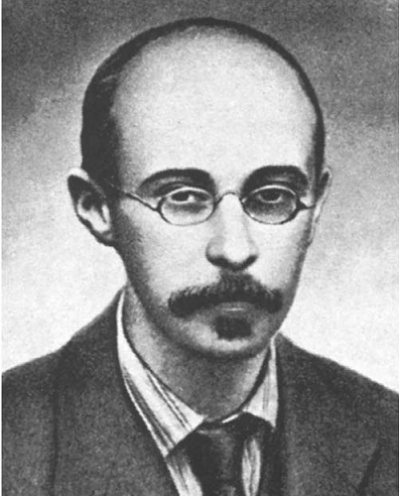
Alexander Friedmann
Alexander Friedmann was a Russian mathematician. Born June 16, 1888, in Saint Petersburg. Died September 16, 1925, in Saint Petersburg. Positions held include professor (1918–1920), dean (1919) and prorector (1919–1920). Known for Friedmann equations, Friedmann–Lemaître–Robertson–Walker metric and dynamic meteorology. Educated at The Second Saint Petersburg Gymnasium and Faculty of Physics and Mathematics of the Saint Petersburg University. Awards include Order of St. George, Order of St. Vladimir, 4th class and Order of Saint Vladimir 4th class with swords and bow.
Facts
51 facts · 2 confirmed by two sources · 21 cited · 28 from one source
Where this comes from
Papalocal keeps its own record. It started from these sources; what each one said is kept here as it was copied, so a change on their side never changes this page by itself. Tap one to read its version.
What Wikidata says · copied November 16, 2026 · revision 2568538288
- Described as
- Russian mathematician (1888-1925)
- Other names
- Alexander Alexandrovich Friedman, Alexander Alexandrovich Friedmann, Friedmann, Alexandr Alexandrovich Friedmann
- Born
- June 16, 1888 · 2 references
- Died
- September 16, 1925 · 6 references
- Born in
- Saint Petersburg · 2 references
- Died in
- Saint Petersburg · 2 references
- Buried in
- Smolenskoye Orthodox Cemetery · 1 reference
- Cause of death
- typhus
- Citizen of
- Russian Empire; Soviet Union
- Occupation
- mathematician · 1 reference; physicist · 1 reference; meteorologist; scientist · 1 reference
- Positions held
- professor (1918–1920); dean (1919); prorector (1919–1920); editor-in-chief (1923–); director (1925–); adjunct professor (1920–) · 1 reference
- Worked for
- St. Petersburg State Transport University (1910–1913) · 1 reference; Saint Petersburg Mining University (1910–1913) · 1 reference; Perm State National Research University (1918–1920) · 1 reference; Saint Petersburg State University (1920–1925) · 2 references; The Voeikov Main Geophysical Observatory (1920–1925) · 1 reference; Vavilov State Optical Institute JSC; Phazotron · 1 reference; N.G. Kuznetsov Naval Academy · 1 reference
- Education
- The Second Saint Petersburg Gymnasium (1897–1906) · 1 reference; Faculty of Physics and Mathematics of the Saint Petersburg University (1906–1910) · 1 reference
- Known for
- Friedmann equations; Friedmann–Lemaître–Robertson–Walker metric; dynamic meteorology · 1 reference
- Awards
- Order of St. George; Order of St. Vladimir, 4th class; Order of Saint Vladimir 4th class with swords and bow · 1 reference; Cross of St. George 4th class · 2 references; Gold Sword for Bravery · 1 reference; Order of St. Vladimir · 1 reference; Lenin Prize · 1 reference
- Field
- theoretical physics; geophysics · 1 reference; theoretical meteorology; cosmology; mathematics · 1 reference; pure mathematics
- Father
- Alexander Friedmann
- Mother
- Ludmila Ignatievna Friedmann · 1 reference
- Military rank
- praporshchik · 1 reference
- Lived in
- Kyiv (1916–1917) · 1 reference; Pavlovsk (1913–1914) · 1 reference; Perm (1918–1920) · 1 reference; Saint Petersburg (1920–) · 1 reference
- Wikipedias with a page
- 58
Wikidata item Q205981 (wikidata.org/wiki/Q205981), public domain (CC0). Copied November 16, 2026.
What Wikipedia says · copied November 16, 2026 · revision 1376056385
Alexander Alexandrovich Friedmann (also spelled Friedman or Fridman; ; Russian: Алекса́ндр Алекса́ндрович Фри́дман; 16 June [O.S. 4 June] 1888 – 16 September 1925) was a Russian and Soviet physicist and mathematician. He originated the pioneering theory that the universe is expanding, governed by a set of equations he developed known as the Friedmann equations.
- Born, in its opening lines
- June 16, 1888
- Died, in its opening lines
- September 16, 1925
From the Wikipedia article “Alexander Friedmann” (en.wikipedia.org/wiki/Alexander_Friedmann), by its contributors, under CC BY-SA 4.0 (creativecommons.org/licenses/by-sa/4.0/). Copied November 16, 2026; not changed.
Confirmed Two sources agree. Cited One source, and it names where it got it. One source One source, without a reference of its own. Sources disagree The sources disagree. We show the best-supported value and keep theirs below.
