
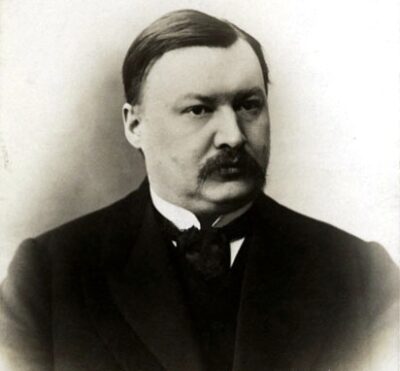
Alexander Glazounov
Alexander Glazounov was a Russian composer, music teacher and conductor. Born July 29, 1865, in Saint Petersburg. Died March 21, 1936, in Paris. Known for String Quartet No. 2 and Saxophone Concerto. Awards include People's Artist of the RSFSR.
Facts
21 facts · 1 confirmed by two sources · 4 cited · 15 from one source · 1 where the sources disagree
What’s different
- Born: we show July 29, 1865 (Sources disagree). Wikipedia says August 10, 1865
Where this comes from
Papalocal keeps its own record. It started from these sources; what each one said is kept here as it was copied, so a change on their side never changes this page by itself. Tap one to read its version.
What Wikidata says · copied November 16, 2026 · revision 2568876877
- Described as
- Russian composer, music teacher and conductor (1865-1936)
- Other names
- Aleksandr Konstantinovich Glazunov, Alexander Konstantinovich Glazunov, A. Glazounow
- Born
- July 29, 1865 · 8 references
- Died
- March 21, 1936 · 12 references
- Born in
- Saint Petersburg · 5 references
- Died in
- Paris · 5 references
- Buried in
- Tikhvin Cemetery
- Citizen of
- Russian Empire; Soviet Union
- Occupation
- composer · 2 references; conductor · 1 reference; pedagogue; musicologist; music educator; university teacher; pianist
- Worked for
- Saint Petersburg Conservatory
- Genre
- symphony; classical music
- Known for
- String Quartet No. 2; Saxophone Concerto
- Awards
- People's Artist of the RSFSR
- Siblings
- Dmitry Glazunov
- Wikipedias with a page
- 57
Wikidata item Q25872 (wikidata.org/wiki/Q25872), public domain (CC0). Copied November 16, 2026.
What Wikipedia says · copied November 16, 2026 · revision 1380555181
Alexander Konstantinovich Glazunov (10 August [O.S. 29 July] 1865 – 21 March 1936) was a Russian composer, music teacher, and conductor of the late Russian Romantic period. He was director of the Saint Petersburg Conservatory between 1905 and 1928 and was instrumental in reorganizing the institute into the Petrograd Conservatory, then the Leningrad Conservatory, after the Bolshevik Revolution. He continued as head of the Conservatory until 1930, though he had left the Soviet Union in 1928 and did not return. The best-known student under his tenure during the early Soviet years was Dmitri Shostakovich.
Glazunov reconciled nationalism and cosmopolitanism in Russian music. While he was the direct successor to Mily Balakirev's nationalism, he tended more towards Alexander Borodin's epic grandeur while absorbing a number of other influences. These included Nikolai Rimsky-Korsakov's orchestral virtuosity, Pyotr Ilyich Tchaikovsky's lyricism and Taneyev's contrapuntal skill. Younger composers such as Sergei Prokofiev and Shostakovich eventually considered his music old-fashioned, while admitting he retained an imposing reputation and was a stabilizing influence in a time of transition and turmoil.
- Born, in its opening lines
- August 10, 1865
- Died, in its opening lines
- March 21, 1936
From the Wikipedia article “Alexander Glazunov” (en.wikipedia.org/wiki/Alexander_Glazunov), by its contributors, under CC BY-SA 4.0 (creativecommons.org/licenses/by-sa/4.0/). Copied November 16, 2026; not changed.
Confirmed Two sources agree. Cited One source, and it names where it got it. One source One source, without a reference of its own. Sources disagree The sources disagree. We show the best-supported value and keep theirs below.
