
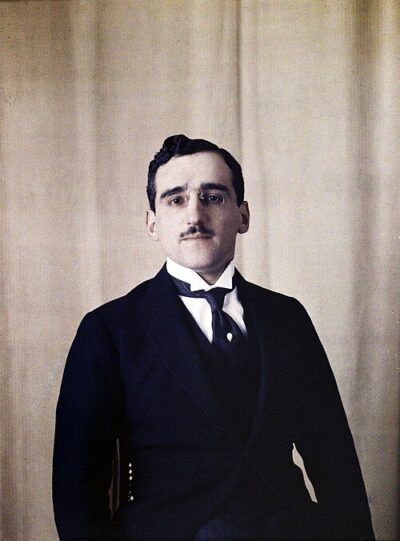
Alexander I of Yugoslavia
Alexander I of Yugoslavia was a Prince regent of Kingdom of Serbia and later King of Yugoslavia 1921–34. Born December 16, 1888, in Cetinje. Died October 9, 1934, in Marseille. Positions held include King of Yugoslavia (1921–1934). Educated at Page Corps. Awards include Knight of the Order of St. Alexander Nevsky, Order of the White Eagle and Godfather promotion of Special Military School of Saint-Cyr.
Facts
39 facts · 2 confirmed by two sources · 2 cited · 35 from one source
Where this comes from
Papalocal keeps its own record. It started from these sources; what each one said is kept here as it was copied, so a change on their side never changes this page by itself. Tap one to read its version.
What Wikidata says · copied November 16, 2026 · revision 2568536758
- Described as
- Prince regent of Kingdom of Serbia and later King of Yugoslavia 1921–34
- Other names
- Alexander I
- Born
- December 16, 1888 · 5 references
- Died
- October 9, 1934 · 8 references
- Born in
- Cetinje · 3 references
- Died in
- Marseille · 3 references
- Buried in
- Oplenac
- Cause of death
- gunshot wound
- Citizen of
- Kingdom of Serbia; Kingdom of Yugoslavia
- Occupation
- monarch
- Positions held
- King of Yugoslavia (1921–1934)
- Education
- Page Corps
- Awards
- Knight of the Order of St. Alexander Nevsky; Order of the White Eagle; Godfather promotion of Special Military School of Saint-Cyr; Order of Saint Anna, 1st class; Order of Saint Stanislaus, 1st class; Order of Michael the Brave; Order of St. Andrew; Order of St. George, 3rd class; Order of St. George, 4th class; Order of St. Sava · 1 reference; Order of the Star of Karađorđe · 1 reference; Order of the White Eagle · 1 reference; Equestrian Order of the Holy Sepulchre · 1 reference; Médaille militaire · 1 reference; Order of Prince Danilo I · 1 reference
- Spouse
- Maria of Yugoslavia (1922–1934) · 1 reference
- Children
- Prince Andrej of Yugoslavia · 1 reference; Peter II of Yugoslavia · 1 reference; Prince Tomislav of Yugoslavia · 1 reference
- Father
- Peter I of Serbia
- Mother
- Princess Zorka of Montenegro
- Siblings
- Princess Jelena of Yugoslavia; Prince George of Yugoslavia; Milena Кarađorđević
- Religion
- Serbian Orthodox Church
- Military rank
- field marshal (Serbia and Yugoslavia) · 1 reference
- Lived in
- Cetinje; Belgrade
- Wikipedias with a page
- 59
Wikidata item Q207384 (wikidata.org/wiki/Q207384), public domain (CC0). Copied November 16, 2026.
What Wikipedia says · copied November 16, 2026 · revision 1383855574
Alexander I Karađorđević (Serbo-Croatian: Александар I Карађорђевић, Aleksandar I Karađorđević, 16 December [O.S. 4 December] 1888 – 9 October 1934) was King of the Serbs, Croats and Slovenes from 16 August 1921 to 3 October 1929 and King of Yugoslavia from 3 October 1929 until his assassination in 1934. His thirteen-year reign was the longest of the kingdom's three monarchs. He served as the de facto head of state of the Kingdom of Serbia from 1914 to 1918 and of Yugoslavia from 1918 to 1921 as prince regent for his father, Peter I.
Born in Cetinje, Montenegro, Alexander was the second son and fourth child of Peter and Zorka Karađorđević. The House of Karađorđević had been deposed in Serbia 30 years earlier by the rival House of Obrenović, and Alexander spent his early life in exile with his father in Montenegro and later Switzerland. He subsequently moved to the Russian Empire and enrolled in the imperial Page Corps. Following the May Coup and the assassination of King Alexander I Obrenović in 1903, Peter ascended the Serbian throne. In 1909, Alexander's elder brother, Prince George, renounced his succession rights, making Alexander heir apparent. Alexander distinguished himself as a field commander during the Balkan Wars, leading Serbian forces to victories over the Ottoman Empire and the Bulgarians. In 1914, he was appointed prince regent after his father transferred his royal duties due to ill health. During the First World War, he held nominal supreme command of the Royal Serbian Army.
In 1918, Alexander oversaw the unification of Serbia and the former Austro-Hungarian provinces of Croatia-Slavonia, Slovenia, Vojvodina, Bosnia and Herzegovina, and Dalmatia into the Kingdom of Serbs, Croats and Slovenes, in accordance with the Corfu Declaration. He subsequently became known as Alexander the Unifier. Alexander continued as prince regent and de facto head of state until ascending the throne upon his father's death in 1921. An extended political crisis followed, culminating in the assassination of Croat political leader Stjepan Radić. In response, Alexander abolished the Vidovdan Constitution in 1929, prorogued parliament, renamed the state the Kingdom of Yugoslavia, and instituted a royal dictatorship. The 1931 Constitution formalised his personal rule and established Yugoslavia as a unitary state, increasing resentment among the non-Serb population. Domestic tensions were further exacerbated by the onset of the Great Depression, which severely affected the country's agrarian economy. In foreign policy, Alexander promoted the Balkan Pact with Greece, Romania, and Turkey, and sought closer relations with Bulgaria.
In October 1934, Alexander made an official visit to the French Republic to consolidate support for the Little Entente against Hungarian revanchism and Italian expansionism. While travelling through Marseille, he was assassinated by Vlado Chernozemski, an operative of the Internal Macedonian Revolutionary Organization acting with support from the Ustaše, led by Ante Pavelić. French Foreign Minister Louis Barthou was also killed in the attack. Alexander was succeeded by his eleven-year-old son, Peter II, under a regency council headed by his cousin Prince Paul.
- Born, in its opening lines
- December 16, 1888
- Died, in its opening lines
- October 9, 1934
From the Wikipedia article “Alexander I of Yugoslavia” (en.wikipedia.org/wiki/Alexander_I_of_Yugoslavia), by its contributors, under CC BY-SA 4.0 (creativecommons.org/licenses/by-sa/4.0/). Copied November 16, 2026; not changed.
Confirmed Two sources agree. Cited One source, and it names where it got it. One source One source, without a reference of its own. Sources disagree The sources disagree. We show the best-supported value and keep theirs below.
