
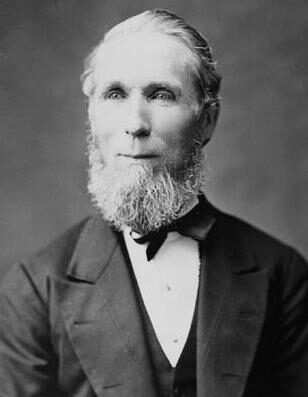
Alexander Mackenzie
Alexander Mackenzie was the 2nd Prime Minister of Canada. Born January 28, 1822, in Logierait. Died April 17, 1892, in Toronto. Positions held include Prime Minister of Canada (1873–1878), Leader of the Liberal Party of Canada (1873–1880) and member of the House of Commons of Canada (1867–1892).
Facts
24 facts · 2 confirmed by two sources · 7 cited · 15 from one source
Where this comes from
Papalocal keeps its own record. It started from these sources; what each one said is kept here as it was copied, so a change on their side never changes this page by itself. Tap one to read its version.
What Wikidata says · copied November 13, 2026 · revision 2568865782
- Described as
- 2nd Prime Minister of Canada (1822-1892)
- Born
- January 28, 1822 · 4 references
- Died
- April 17, 1892 · 3 references
- Born in
- Logierait
- Died in
- Toronto · 1 reference
- Buried in
- Lakeview Cemetery
- Cause of death
- stroke
- Name at birth
- Alexander Mackenzie
- Citizen of
- Canada
- Occupation
- politician · 1 reference; journalist · 1 reference; entrepreneur; writer; stonemason · 1 reference; editor · 1 reference; businessperson · 1 reference
- Positions held
- Prime Minister of Canada (1873–1878); Leader of the Liberal Party of Canada (1873–1880); member of the House of Commons of Canada (1867–1892) · 1 reference
- Political party
- Liberal Party of Canada
- Spouse
- Jane Mackenzie
- Siblings
- Charles MacKenzie; Hope Fleming Mackenzie
- Religion
- Baptists
- Military rank
- major
- Wikipedias with a page
- 44
Wikidata item Q128708 (wikidata.org/wiki/Q128708), public domain (CC0). Copied November 13, 2026.
What Wikipedia says · copied November 13, 2026 · revision 1382669547
Alexander Mackenzie (January 28, 1822 – April 17, 1892) was a Scottish-Canadian stonemason and politician who served as the second prime minister of Canada from 1873 to 1878. He led the Liberal Party from 1873 to 1880 and was the first Liberal prime minister. He was also a member of Parliament (MP) from 1867 to 1892.
Mackenzie was born in Logierait, Perthshire, Scotland. He left school at the age of 13, following his father's death, to help his widowed mother, and trained as a stonemason. Mackenzie immigrated to the Province of Canada when he was 19, settling in what became Ontario. His masonry business prospered, allowing him to pursue other interests – such as the editorship of a pro-Reformist newspaper called the Lambton Shield. Mackenzie was elected to the Legislative Assembly of the Province of Canada in 1862, as a supporter of George Brown.
In 1867, Mackenzie was elected to the new House of Commons of Canada for the Liberal Party. He became leader of the party (and thus leader of the Opposition) in mid-1873, and a few months later, following John A. Macdonald's resignation in the aftermath of the Pacific Scandal, he succeeded Macdonald as prime minister. Mackenzie and the Liberals won a majority government in the 1874 federal election. He was popular among the general public for his humble background and consistent democratic principles.
As prime minister, Mackenzie continued the nation-building program which began under his predecessor. His government introduced the secret ballot, established the Supreme Court of Canada and Royal Military College of Canada, enacted the Indian Act, and created the District of Keewatin to better administer Canada's newly acquired western territories. It struggled to deal with the aftermath of the Panic of 1873 and made limited progress on the transcontinental railway. Mackenzie's Liberals were defeated in the 1878 federal election. He remained leader of the Liberal Party for another two years, and continued on as an MP until his death from a stroke.
- Born, in its opening lines
- January 28, 1822
- Died, in its opening lines
- April 17, 1892
From the Wikipedia article “Alexander Mackenzie (politician)” (en.wikipedia.org/wiki/Alexander_Mackenzie_(politician)), by its contributors, under CC BY-SA 4.0 (creativecommons.org/licenses/by-sa/4.0/). Copied November 13, 2026; not changed.
Confirmed Two sources agree. Cited One source, and it names where it got it. One source One source, without a reference of its own. Sources disagree The sources disagree. We show the best-supported value and keep theirs below.
