
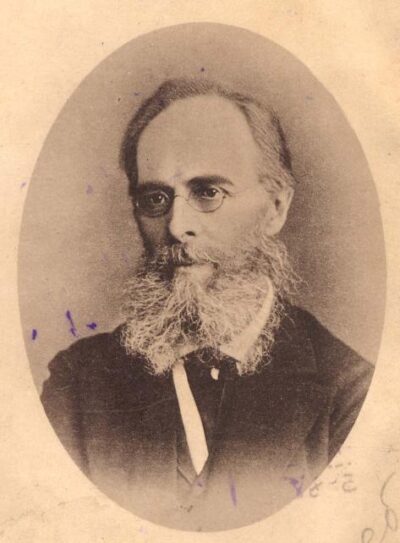
Alexander Potebnja
Alexander Potebnja was a Russian philosopher. Born September 22, 1835, in Romensky Uyezd. Died December 11, 1891, in Kharkiv. Educated at Imperial Kharkov University. Awards include Constantin Medal and Lomonosov Prize.
Facts
21 facts · 2 confirmed by two sources · 3 cited · 15 from one source · 1 where the sources disagree
What’s different
- Born: we show September 22, 1835 (Confirmed). Wikidata also lists September 10, 1835
- Died: we show December 11, 1891 (Confirmed). Wikidata also lists November 29, 1891
- Buried in: we show St. John Useknovensky cemetery (Sources disagree). Wikidata also lists Thirteenth City Cemetery, Kharkiv
Where this comes from
Papalocal keeps its own record. It started from these sources; what each one said is kept here as it was copied, so a change on their side never changes this page by itself. Tap one to read its version.
What Wikidata says · copied November 18, 2026 · revision 2568343066
- Described as
- Russian philosopher (1835-1891)
- Born
- September 10, 1835 · 1 reference; September 22, 1835 · 1 reference
- Died
- November 29, 1891; December 11, 1891 · 2 references
- Born in
- Romensky Uyezd
- Died in
- Kharkiv · 1 reference
- Buried in
- St. John Useknovensky cemetery; Thirteenth City Cemetery, Kharkiv (1970–)
- Citizen of
- Russian Empire
- Occupation
- linguist · 1 reference; philosopher; literary scholar; writer · 1 reference; slavist · 1 reference; philologist · 1 reference
- Worked for
- National University of Kharkiv; Imperial Kharkov University · 1 reference
- Education
- Imperial Kharkov University · 1 reference
- Member of
- Saint Petersburg Academy of Sciences
- Awards
- Constantin Medal; Lomonosov Prize · 1 reference
- Field
- linguistics; volkerpsychologie
- Children
- Andrey Alexandrovich Potebnia
- Wikipedias with a page
- 23
Wikidata item Q683690 (wikidata.org/wiki/Q683690), public domain (CC0). Copied November 18, 2026.
What Wikipedia says · copied November 18, 2026 · revision 1366930451
Alexander Afanasyevich Potebnja (Russian: Алекса́ндр Афана́сьевич Потебня́; Ukrainian: Олекса́ндр Опана́сович Потебня́, romanized: Oleksandr Opanasovych Potebnia; September 22, 1835 – December 11, 1891) was a Russian Imperial and Ukrainian linguist, philosopher and pan-Slavist of Ukrainian Cossack descent, who was a professor of linguistics at the Imperial Kharkov University. He is well known as a specialist in the evolution of Russian phonetics.
He constructed a theory of language and consciousness that later influenced the thinking of his countryman the Psychologist Lev Vygotsky. His main work was Language and Thought (Russian: Мысль и язык) (1862). He also published a number of works on Russian Grammar, on the History of the Sounds in the Russian Language and on Slavic folk poetry, furthermore he translated a short fragment of Homer's Odyssey into Ukrainian. Potebnja was a corresponding member of the St. Petersburg Academy of Sciences, the foremost academic institution in the Russian Empire.
- Born, in its opening lines
- September 22, 1835
- Died, in its opening lines
- December 11, 1891
From the Wikipedia article “Alexander Potebnja” (en.wikipedia.org/wiki/Alexander_Potebnja), by its contributors, under CC BY-SA 4.0 (creativecommons.org/licenses/by-sa/4.0/). Copied November 18, 2026; not changed.
Confirmed Two sources agree. Cited One source, and it names where it got it. One source One source, without a reference of its own. Sources disagree The sources disagree. We show the best-supported value and keep theirs below.
