
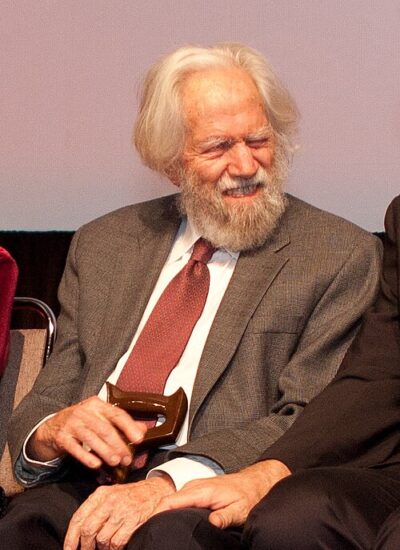
Alexander Shulgin
Alexander Shulgin was an American medicinal chemist, biochemist, pharmacologist, psychopharmacologist, and author. Born June 17, 1925, in Berkeley. Died June 2, 2014, in Berkeley. Known for Phenethylamines I Have Known And Loved and Tryptamines I Have Known and Loved. Educated at Harvard University and University of California, Berkeley.
Facts
21 facts · 2 confirmed by two sources · 3 cited · 16 from one source
Where this comes from
Papalocal keeps its own record. It started from these sources; what each one said is kept here as it was copied, so a change on their side never changes this page by itself. Tap one to read its version.
What Wikidata says · copied November 15, 2026 · revision 2553830306
- Described as
- American medicinal chemist, biochemist, pharmacologist, psychopharmacologist, and author (1925–2014)
- Other names
- Alexander Theodore Shulgin, Sasha Shulgin, Alexander "Sasha" Theodore Shulgin, Godfather of Ecstasy
- Born
- June 17, 1925 · 1 reference
- Died
- June 2, 2014
- Born in
- Berkeley · 1 reference
- Died in
- Berkeley
- Cause of death
- liver cancer
- Citizen of
- United States
- Occupation
- biochemist; pharmacologist · 2 references; chemist · 1 reference; writer · 1 reference; pharmacist · 1 reference
- Education
- Harvard University; University of California, Berkeley; University of California, San Francisco
- Known for
- Phenethylamines I Have Known And Loved; Tryptamines I Have Known and Loved
- Field
- psychopharmacology; medicinal chemistry
- Spouse
- Ann Shulgin
- Military branch
- United States Navy
- Website
- http://www.cognitiveliberty.org/shulgin/blg/index.html
- Wikipedias with a page
- 30
Wikidata item Q506336 (wikidata.org/wiki/Q506336), public domain (CC0). Copied November 15, 2026.
What Wikipedia says · copied November 15, 2026 · revision 1383296829
Alexander Theodore "Sasha" Shulgin (June 17, 1925 – June 2, 2014) was an American biochemist who synthesized and tested over 200 psychedelic and related chemical compounds. Among the most notable psychedelic and related drugs that Shulgin developed include 2C-B, DOM (STP), and Ariadne (4C-D; BL-3912; Dimoxamine). In addition, he is known for discovering and describing the unique effects of the entactogen MDMA (ecstasy), which led to its use in MDMA-assisted psychotherapy and to its widespread use as a recreational drug, for instance in the rave scene.
Shulgin studied chemistry at Harvard University and the University of California, Berkeley and received his Ph.D. in biochemistry in 1955. He developed the best-selling biodegradable pesticide mexacarbate (Zectran) while working at Dow Chemical Company in the early 1960s. Shulgin became interested in psychedelic chemistry after having his first psychedelic experience in 1960 and from then on began developing new psychedelic compounds in his lab at his home in Lafayette, California. His approach was to synthesize the compounds, test them on himself and a small group of trusted others, and document his findings. He formally published on psychedelics in the scientific literature for decades, before publishing his books PiHKAL: A Chemical Love Story (Phenethylamines I Have Known and Loved) in 1991 and TiHKAL: The Continuation (Tryptamines I Have Known and Loved) in 1997. These books documented his and others' work with hundreds of phenethylamines, tryptamines, and lysergamides, including their chemical syntheses, properties and effects, and discussion. They were coauthored by Shulgin and by his wife Ann Shulgin, a pioneering psychedelic therapist, whom he met in 1978 and married in 1981. Shulgin was an academic and taught at universities such as the University of California, Berkeley, the University of California, San Francisco, and San Francisco State University.
Shulgin had a close and friendly relationship with the Drug Enforcement Administration (DEA) for many decades and held a DEA license to work with Schedule I controlled substances. Following the publication of PiHKAL however, Shulgin's lab was raided by the DEA in 1993. He was stripped of his license and fined due to a violation of its terms. According to a DEA representative, "It is our opinion that those books are pretty much cookbooks on how to make illegal drugs." There have also been overdoses and deaths due to compounds that Shulgin developed, which he has expressed frustration and sadness about, but also emphasized personal freedom and that all drugs have risks. During his life, Shulgin advocated for use of psychedelics and for legalization of all drugs. He has historically been a polarizing figure, seen variously as a "hero of the counterculture", "curiosity", and "menace".
Shulgin has been described as the "greatest psychedelic chemist of all time". He has also been dubbed the "godfather of ecstasy" and as the "godfather of psychedelics". Several documentaries have been made about Shulgin and his work and life. Transform Press, the publisher of PiHKAL and TiHKAL, and the Alexander Shulgin Research Institute (ASRI) were founded by Shulgin and/or by his family and close colleagues. In addition, Shulgin's home and lab, known as the Shulgin Farm, have been memorialized as a center for psychedelic education and community. Shulgin died in 2014 at the age of 88 and was followed by his wife Ann Shulgin in 2022. As of the 2020s, many psychedelics and entactogens, including some associated with Shulgin like MDMA, are under investigation for potential medical use to treat mental health conditions.
- Born, in its opening lines
- June 17, 1925
- Died, in its opening lines
- June 2, 2014
From the Wikipedia article “Alexander Shulgin” (en.wikipedia.org/wiki/Alexander_Shulgin), by its contributors, under CC BY-SA 4.0 (creativecommons.org/licenses/by-sa/4.0/). Copied November 15, 2026; not changed.
Confirmed Two sources agree. Cited One source, and it names where it got it. One source One source, without a reference of its own. Sources disagree The sources disagree. We show the best-supported value and keep theirs below.
