
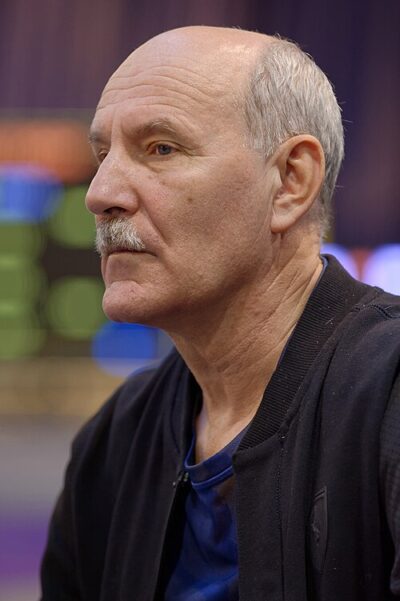
Alexandr Romankov is a Soviet fencer. Born November 7, 1953, in Korsakov. Educated at Belarusian State University of Physical Culture. Awards include Order of Friendship of Peoples, Order of the Badge of Honour and Medal "For Labour Valour".
Facts
12 facts · 0 confirmed by two sources · 3 cited · 9 from one source
Where this comes from
Papalocal keeps its own record. It started from these sources; what each one said is kept here as it was copied, so a change on their side never changes this page by itself. Tap one to read its version.
What Wikidata says · copied November 18, 2026 · revision 2518923044
- Described as
- Soviet fencer
- Other names
- Alexandr Anatolyevich Romankov
- Born
- November 7, 1953 · 1 reference
- Born in
- Korsakov · 1 reference
- Citizen of
- Soviet Union; Belarus
- Occupation
- fencer
- Education
- Belarusian State University of Physical Culture
- Sport
- fencing
- Awards
- Order of Friendship of Peoples; Order of the Badge of Honour; Medal "For Labour Valour"; Honoured Master of Sports of the USSR
- Height
- 1.78 m (5 ft 10 in) · 1 reference
- Wikipedias with a page
- 22
Wikidata item Q2418137 (wikidata.org/wiki/Q2418137), public domain (CC0). Copied November 18, 2026.
What Wikipedia says · copied November 18, 2026 · revision 1363333242
Alexandr Anatolyevich Romankov (Belarusian: Аляксандр Анатольевіч Раманькоў, romanized: Alyaksandr Anatolyevich Ramankow; Russian: Александр Анатольевич Романьков, romanized: Aleksandr Anatolyevich Romankov) is a former Belarusian fencer from the former Soviet Union, who was born on 7 November 1953 in the town of Korsakov on the island of Sakhalin (just north of Japan). He trained at Dynamo in Minsk and won a gold medal, two silver medals and two bronze medals at the three Olympic Games that he competed in between 1976 and 1988 ) .
From the Wikipedia article “Alexandr Romankov” (en.wikipedia.org/wiki/Alexandr_Romankov), by its contributors, under CC BY-SA 4.0 (creativecommons.org/licenses/by-sa/4.0/). Copied November 18, 2026; not changed.
Confirmed Two sources agree. Cited One source, and it names where it got it. One source One source, without a reference of its own. Sources disagree The sources disagree. We show the best-supported value and keep theirs below.
