
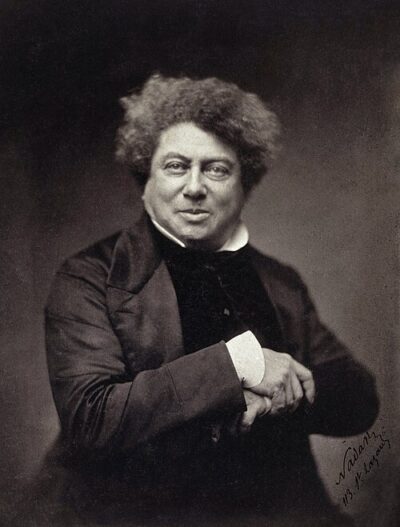
Alexandre Dumas
Alexandre Dumas was a French writer and dramatist. Born July 24, 1802, in Villers-Cotterêts. Died December 5, 1870, in Puys. Positions held include president of the Société des gens de lettres (1840). Known for The Count of Monte Cristo, The Three Musketeers and La Reine Margot. Awards include Knight of the Legion of Honour, Knight of the Order of the Netherlands Lion and Officer of the Legion of Honour.
Facts
40 facts · 2 confirmed by two sources · 13 cited · 25 from one source
Where this comes from
Papalocal keeps its own record. It started from these sources; what each one said is kept here as it was copied, so a change on their side never changes this page by itself. Tap one to read its version.
What Wikidata says · copied November 16, 2026 · revision 2565594277
- Described as
- French writer and dramatist (1802–1870)
- Other names
- Alexandre Dumas, père, Alexandre Dumas, father, Alexandre Dumas, the Elder, Alexandre Dumas pere, Alexandre Dumas père, Alexandre Dumas Davy de la Pailleterie, Dumas Davy de la Pailleterie
- Born
- July 24, 1802 · 20 references
- Died
- December 5, 1870 · 18 references
- Born in
- Villers-Cotterêts · 5 references
- Died in
- Puys · 1 reference
- Buried in
- Panthéon (2002–) · 1 reference; Communal Cemetery of Villers-Cotterêts (–2002) · 1 reference
- Cause of death
- stroke
- Name at birth
- Alexandre Dumas Davy de la Pailleterie
- Citizen of
- France · 1 reference
- Occupation
- novelist; playwright · 1 reference; writer · 3 references
- Positions held
- president of the Société des gens de lettres (1840)
- Member of
- Order of Isabella the Catholic
- Known for
- The Count of Monte Cristo; The Three Musketeers; La Reine Margot; Twenty Years After; La Dame de Monsoreau; Joseph Balsamo; The Forty-five Guardsmen; The Vicomte of Bragelonne: Ten Years Later; The Queen's Necklace; The Countess of Charny
- Awards
- Knight of the Legion of Honour (1837) · 1 reference; Knight of the Order of the Netherlands Lion · 2 references; Officer of the Legion of Honour · 1 reference; Order of Isabella the Catholic · 1 reference; Order of Charles III · 1 reference; Order of Glory · 1 reference; Decoration for the Civil Merit under the title of Saint Louis, First class · 1 reference
- Field
- French literature
- Spouse
- Ida Ferrier (1840–1859) · 1 reference
- Children
- Alexandre Dumas fils · 3 references; Henry Bauër; Marie Alexandrine Dumas; Micaëlla Cordier
- Father
- Thomas-Alexandre Dumas · 1 reference
- Mother
- Marie-Louise-Élisabeth Labouret Dumas
- Lived in
- former 2nd arrondissement of Paris (1843)
- Wikipedias with a page
- 174
Wikidata item Q38337 (wikidata.org/wiki/Q38337), public domain (CC0). Copied November 16, 2026.
What Wikipedia says · copied November 16, 2026 · revision 1383878319
Alexandre Dumas (born Alexandre Davy de la Pailleterie; 24 July 1802 – 5 December 1870), also known as Alexandre Dumas père, was a French novelist and playwright.
His works have been translated into many languages and he is one of the most widely read French authors. Many of his historical novels of adventure were originally published as serials, including The Count of Monte Cristo, The Three Musketeers, Twenty Years After and The Vicomte of Bragelonne: Ten Years Later. He also wrote many plays and, since the early 20th century, many of his novels have been adapted into films. Prolific in several genres, Dumas began his career by writing plays, which were successfully produced from the first. He wrote numerous magazine articles and travel books; his published works totalled 100,000 pages. In the 1840s, Dumas founded the Théâtre Historique in Paris.
His father, General Thomas-Alexandre Dumas, né Davy de la Pailleterie, was born in the French colony of Saint-Domingue (present-day Haiti) to Alexandre Antoine Davy de la Pailleterie, a French nobleman, and Marie-Cessette Dumas, an African slave. At age 14, Thomas-Alexandre was taken by his father to France, where he was given his freedom, educated in a military academy, and entered the military for what became an illustrious career.
Alexandre acquired work with Louis-Philippe, Duke of Orléans, then as a writer, a career that led to his early success. Decades later, after the election of Louis-Napoléon Bonaparte in 1851, Dumas fell from favour and left France for Belgium, where he stayed for several years. He moved to Russia for a few years and then to Italy. In 1861, he founded and published the newspaper L'Indépendant, which supported Italian unification. He returned to Paris in 1864.
English playwright Watts Phillips, who knew Dumas in his later life, described him as "the most generous, large-hearted being in the world. He also was the most delightfully amusing and egotistical creature on the face of the earth. His tongue was like a windmill—once set in motion, you would never know when he would stop, especially if the theme was himself."
- Born, in its opening lines
- July 24, 1802
- Died, in its opening lines
- December 5, 1870
From the Wikipedia article “Alexandre Dumas” (en.wikipedia.org/wiki/Alexandre_Dumas), by its contributors, under CC BY-SA 4.0 (creativecommons.org/licenses/by-sa/4.0/). Copied November 16, 2026; not changed.
Confirmed Two sources agree. Cited One source, and it names where it got it. One source One source, without a reference of its own. Sources disagree The sources disagree. We show the best-supported value and keep theirs below.
