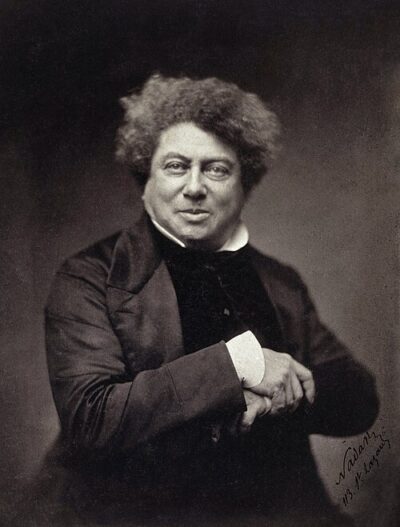
The Forty-five Guardsmen
The Forty-five Guardsmen is a novel by Alexandre Dumas père. It came out in 1847.
- Published
- 1847
- Came out
- 1848
- Written by
- Alexandre Dumas
- Genre
- historical fiction
- Country of origin
- France
All 9 facts, and where they come from
Facts
9 facts · 0 confirmed by two sources · 0 cited · 9 from one source
Where this comes from
Papalocal keeps its own record. It started from these sources; what each one said is kept here as it was copied, so a change on their side never changes this page by itself. Tap one to read its version.
What Wikidata says · copied November 17, 2026 · revision 2488021453
- Described as
- novel by Alexandre Dumas père
- Other names
- The Forty-five
- What it is
- literary work
- Written by
- Alexandre Dumas
- Genre
- historical fiction
- Published
- 1847
- Language
- French
- Country of origin
- France
- Comes after
- La Dame de Monsoreau
- Came out
- 1848
- Named after
- The forty-five guards
- Wikipedias with a page
- 14
Wikidata item Q2300607 (wikidata.org/wiki/Q2300607), public domain (CC0). Copied 2026-11-17.
What Wikipedia says · copied November 17, 2026 · revision 1384472206
The Forty-Five Guardsmen (Les Quarante-cinq in French) is a historical novel by French writer Alexandre Dumas, written between 1847 and 1848 in collaboration with Auguste Maquet. Set in 1585 and 1586 during the French Wars of Religion, it is the third and final work in his Valois trilogy, concluding the events of La Reine Margot and La Dame de Monsoreau, and again featuring Chicot the Jester.
It tells the story of Diane de Méridor's quest for revenge upon the Duke of Anjou – for his betrayal of Bussy d’Amboise. The novel features Forty-five guards - lesser nobility recruited by Jean Louis de Nogaret de La Valette, Duke of Épernon, to provide Henry III of France with trusted protection in the midst of the War of the Three Henrys.
The story opens thirteen years after the Saint Bartholomew's Day Massacre and ten years into the reign of Henry III as he tries to calm the religious and political intrigues dividing the kingdom. Dumas fictionalised the action, including Henry of Navarre's capture of Cahors (which actually occurred in 1580) and the attack on Antwerp (re-dated by Dumas from 1583 to 1585 or 1586) and including William the Silent (who had actually been assassinated in 1584) and the Duke of Anjou (who died of tuberculosis in 1584 but who Dumas shows being encouraged to covet the crown of the Low Countries by William and fulfilling a prediction by Côme Ruggieri in La Reine Margot). He also makes Count Henri du Bouchage's retreat from the world to become a Capuchin friar a result of the coldness of Diane de Méridor, whereas historically he did so from grief for his wife's death.
From the Wikipedia article “The Forty-Five Guardsmen” (en.wikipedia.org/wiki/The_Forty-Five_Guardsmen), by its contributors, under CC BY-SA 4.0 (creativecommons.org/licenses/by-sa/4.0/). Copied 2026-11-17; not changed.
Confirmed Two sources agree. Cited One source, and it names where it got it. One source One source, without a reference of its own. Sources disagree The sources disagree. We show the best-supported value and keep theirs below.
Picture: Wikimedia Commons: Dumas60.JPG · See Commons file page