
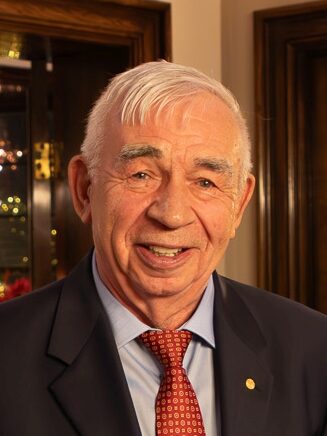
Alexey Ekimov
Alexey Ekimov is a Russian physicist. Born February 28, 1945, in Saint Petersburg. Educated at Faculty of Physics, State University of Saint Petersbourg. Awards include R. W. Wood Prize, USSR State Prize and Nobel Prize in Chemistry.
Facts
17 facts · 0 confirmed by two sources · 2 cited · 15 from one source
Where this comes from
Papalocal keeps its own record. It started from these sources; what each one said is kept here as it was copied, so a change on their side never changes this page by itself. Tap one to read its version.
What Wikidata says · copied November 13, 2026 · revision 2563201226
- Described as
- Russian physicist
- Other names
- Alexei Ekimov, Alexei I. Ekimov, Alexei Ivanovich Ekimov, Alexei Ivanovich Yekimov, Alexei Yekimov, Aleksey Yekimov
- Born
- February 28, 1945
- Born in
- Saint Petersburg
- Citizen of
- Soviet Union (–1991); Russia (1991–); United States
- Occupation
- physicist
- Worked for
- Vavilov State Optical Institute JSC; Ioffe Institute; École polytechnique; Claude Bernard University Lyon 1; Max Planck Society; University of Osaka
- Education
- Faculty of Physics, State University of Saint Petersbourg (–1967)
- Awards
- R. W. Wood Prize (2006) · 1 reference; USSR State Prize (1976); Nobel Prize in Chemistry (2023) · 2 references
- Field
- solid-state physics
- Wikipedias with a page
- 49
Wikidata item Q1547368 (wikidata.org/wiki/Q1547368), public domain (CC0). Copied November 13, 2026.
What Wikipedia says · copied November 13, 2026 · revision 1379680426
Alexey Ekimov or Aleksey Yekimov (Russian: Алексей Екимов; born 1945) is a Russian solid state physicist and a pioneer in nanomaterials research. He discovered the semiconductor nanocrystals known as quantum dots in 1981, while working at the Vavilov State Optical Institute. In 2023, he was awarded the Nobel Prize in Chemistry for this discovery.
From the Wikipedia article “Alexey Ekimov” (en.wikipedia.org/wiki/Alexey_Ekimov), by its contributors, under CC BY-SA 4.0 (creativecommons.org/licenses/by-sa/4.0/). Copied November 13, 2026; not changed.
Confirmed Two sources agree. Cited One source, and it names where it got it. One source One source, without a reference of its own. Sources disagree The sources disagree. We show the best-supported value and keep theirs below.
