
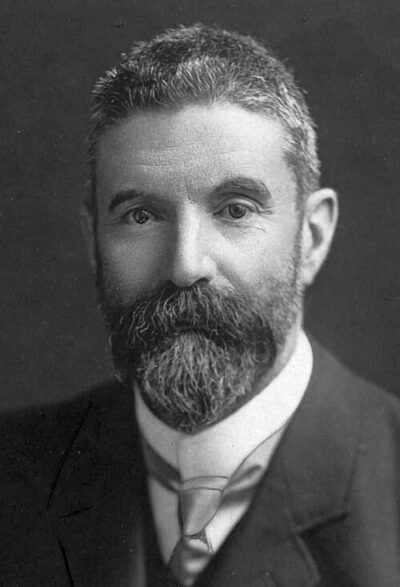
Alfred Deakin
Alfred Deakin was an Australian politician. Born August 3, 1856, in Melbourne. Died October 7, 1919, in Melbourne. Positions held include Prime Minister of Australia (1903–1910), Attorney-General for Australia (1901–1903) and member of the Australian House of Representatives (1901–1913). Educated at Melbourne Law School. Awards include Australian Media Hall of Fame.
Facts
25 facts · 2 confirmed by two sources · 7 cited · 16 from one source
Where this comes from
Papalocal keeps its own record. It started from these sources; what each one said is kept here as it was copied, so a change on their side never changes this page by itself. Tap one to read its version.
What Wikidata says · copied November 16, 2026 · revision 2562815196
- Described as
- Australian politician (1856–1919)
- Other names
- The Honourable Alfred Deakin
- Born
- August 3, 1856 · 7 references
- Died
- October 7, 1919 · 7 references
- Born in
- Melbourne · 1 reference
- Died in
- Melbourne · 1 reference
- Buried in
- St Kilda Cemetery · 2 references
- Cause of death
- Alzheimer's disease
- Citizen of
- Australia
- Occupation
- politician; diplomat; journalist; poet
- Positions held
- Prime Minister of Australia (1903–1910); Attorney-General for Australia (1901–1903); member of the Australian House of Representatives (1901–1913); Minister for Foreign Affairs (Australia) (1905–1908); Member of the Victorian Legislative Assembly (1879–1900)
- Political party
- Protectionist Party
- Education
- Melbourne Law School
- Awards
- Australian Media Hall of Fame · 1 reference
- Spouse
- Pattie Deakin (1882–) · 2 references
- Children
- Vera Deakin White; Ivy Brookes · 1 reference; Stella Deakin · 1 reference
- Father
- William Deakin · 1 reference
- Siblings
- Catherine Deakin
- Wikipedias with a page
- 57
Wikidata item Q313805 (wikidata.org/wiki/Q313805), public domain (CC0). Copied November 16, 2026.
What Wikipedia says · copied November 16, 2026 · revision 1385904438
Alfred Deakin (3 August 1856 – 7 October 1919) was the second prime minister of Australia. He served three terms from 1903 to 1904, from 1905 to 1908, and from 1909 to 1910. He held office as the leader of the Protectionist Party, and in his final term as that of the Liberal Party. He is notable for being one of the fathers of Federation and for his influence in early Australian politics.
Deakin was born in Melbourne to middle-class parents. He was elected to the Victorian Legislative Assembly in 1879, aged 23, additionally working as a barrister and journalist. He held ministerial office sporadically beginning in 1883, aligning himself with liberal and radical reformers. In the 1890s, Deakin became one of the leading figures in the movement for the federation of the Australian colonies. He was a delegate to the federal conventions and served on the committees that drafted the federal constitution. He later campaigned at a series of referendums and lobbied the British government for its adoption.
After the Federation in 1901, Deakin became the inaugural attorney-general of Australia in the ministry led by his close friend Edmund Barton. He succeeded Barton as prime minister in September 1903. Two subsequent elections in 1903 and 1906 produced an even split between three parties, with Deakin's Liberal Protectionist Party occupying an effective middle ground between the Free Traders and the Australian Labor Party (ALP). He left office in April 1904 following an unproductive first term but returned in July 1905 and was able to form a functional government with the support of the ALP. He relinquished office again in August 1908.
In 1909, in what became known as the Fusion, Deakin controversially led his supporters into a union with the Free Traders. Their alliance, based on anti-socialism, marked the beginning of a two-party system in federal politics and allowed him to form Australia's first majority government. Deakin regarded his final term as prime minister, from June 1909 to April 1910, as his most productive. However, to his surprise, the ALP won a majority in both houses at the 1910 election. He retired from politics in 1913, in the early stages of a degenerative neurological condition that led to his death at the age of 63.
Deakin is regarded as one of Australia's most influential prime ministers. He was the principal architect of the "Australian settlement", the features of which – the White Australia policy, compulsory arbitration, protectionism, state paternalism, and support for the British Empire – formed the basis of Australia's socio-economic framework well into the 20th century.
- Born, in its opening lines
- August 3, 1856
- Died, in its opening lines
- October 7, 1919
From the Wikipedia article “Alfred Deakin” (en.wikipedia.org/wiki/Alfred_Deakin), by its contributors, under CC BY-SA 4.0 (creativecommons.org/licenses/by-sa/4.0/). Copied November 16, 2026; not changed.
Confirmed Two sources agree. Cited One source, and it names where it got it. One source One source, without a reference of its own. Sources disagree The sources disagree. We show the best-supported value and keep theirs below.
