
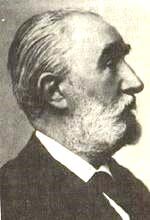
Alfred Grandidier
Alfred Grandidier was a French naturalist and explorer. Born December 20, 1836, in Paris. Died September 13, 1921, in Paris. Awards include Founder’s Medal, Grande Médaille d'Or des Explorations and Commander of the Legion of Honour.
Facts
20 facts · 2 confirmed by two sources · 8 cited · 10 from one source
Where this comes from
Papalocal keeps its own record. It started from these sources; what each one said is kept here as it was copied, so a change on their side never changes this page by itself. Tap one to read its version.
What Wikidata says · copied November 18, 2026 · revision 2565515047
- Described as
- French naturalist and explorer (1836–1921)
- Other names
- Grandid., Grandidier
- Born
- December 20, 1836 · 3 references
- Died
- September 13, 1921 · 5 references
- Born in
- Paris · 1 reference
- Died in
- Paris · 1 reference
- Citizen of
- France · 1 reference
- Occupation
- explorer; entomologist; ornithologist; botanist · 1 reference; zoologist; geographer · 2 references; naturalist · 1 reference
- Member of
- French Academy of Sciences; Ligue de la Patrie Française
- Awards
- Founder’s Medal (1906) · 1 reference; Grande Médaille d'Or des Explorations (1872); Commander of the Legion of Honour · 1 reference
- Field
- natural history · 1 reference
- Children
- Guillaume Grandidier
- Siblings
- Ernest Grandidier · 1 reference
- Wikipedias with a page
- 23
Wikidata item Q727876 (wikidata.org/wiki/Q727876), public domain (CC0). Copied November 18, 2026.
What Wikipedia says · copied November 18, 2026 · revision 1315297910
Alfred Grandidier (French pronunciation: [alfʁɛd ɡʁɑ̃didje]; 20 December 1836 – 13 September 1921) was a French naturalist and explorer from a very wealthy family.
At the age of 20, he and his brother, Ernest Grandidier (1833–1912), undertook a voyage around the world. At first they were led by the astronomer and physicist Pierre Jules César Janssen (1824–1907), but when Janssen fell sick and had to return to France after about six months, the brothers continued the journey.
They visited South America in 1858 and 1859 and in particular the Andes, Peru, Chile, Bolivia, Argentina and Brazil. During this voyage they gathered a significant collection of specimens which were analyzed, in 1860, by Ernest.
The two brothers parted ways after this. Ernest Grandidier went to China and collected a vast number of specimens which are now in the Louvre and the Guimet museum. Alfred travelled to India, reaching it in 1863. He had intended to explore the high plateau of Tibet, but was prevented by a severe attack of fever.
Grandidier travelled to Zanzibar to recuperate, remaining some time and making important collections and publishing an account of his findings. He then visited the island of Réunion and in 1865 made his first visit to Madagascar. He became devoted to the study of the island, revisiting in 1866 and 1868. He finally returned permanently to France in 1870. During his explorations he crossed the island three times, travelling 3,000 kilometers in the interior and 2,500 along the coast. He made observations which resulted in the production of a map of the island used in future expeditions.After returning to France he began to work on his great work, L'Histoire physique, naturelle et politique de Madagascar. This work was undertaken in cooperation with others such as Alphonse Milne-Edwards and Leon Vaillant. This work ran to 40 volumes, the final volumes published posthumously by his son Guillaume Grandidier. He described about 50 new species of reptiles and amphibians.
Alfred Grandidier's work drew the attention of the French government to Madagascar, which it would annex at the end of 1890.
He was elected to the French Academy of Sciences in 1885 and was the president of the French Geographical Society from 1901 to 1905. The Royal Geographical Society awarded him their Founder's Medal in 1906.
- Born, in its opening lines
- December 20, 1836
- Died, in its opening lines
- September 13, 1921
From the Wikipedia article “Alfred Grandidier” (en.wikipedia.org/wiki/Alfred_Grandidier), by its contributors, under CC BY-SA 4.0 (creativecommons.org/licenses/by-sa/4.0/). Copied November 18, 2026; not changed.
Confirmed Two sources agree. Cited One source, and it names where it got it. One source One source, without a reference of its own. Sources disagree The sources disagree. We show the best-supported value and keep theirs below.
