
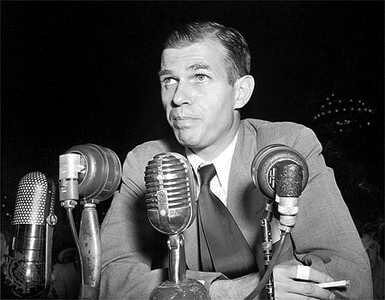
Alger Hiss
Alger Hiss was an American government official who was accused of spying for the Soviet Union. Born November 11, 1904, in Baltimore. Died November 15, 1996, in New York City. Educated at Johns Hopkins University and Harvard Law School.
Facts
15 facts · 2 confirmed by two sources · 5 cited · 8 from one source
Where this comes from
Papalocal keeps its own record. It started from these sources; what each one said is kept here as it was copied, so a change on their side never changes this page by itself. Tap one to read its version.
What Wikidata says · copied November 15, 2026 · revision 2557705580
- Described as
- American government official who was accused of spying for the Soviet Union (1904–1996)
- Born
- November 11, 1904 · 9 references
- Died
- November 15, 1996 · 9 references
- Born in
- Baltimore · 2 references
- Died in
- New York City · 2 references
- Citizen of
- United States
- Occupation
- jurist; lawyer · 1 reference; diplomat; politician · 1 reference
- Education
- Johns Hopkins University; Harvard Law School
- Member of
- Phi Beta Kappa Society
- Spouse
- Priscilla Hiss
- Children
- Tony Hiss · 1 reference
- Siblings
- Donald Hiss · 1 reference
- Wikipedias with a page
- 28
Wikidata item Q549966 (wikidata.org/wiki/Q549966), public domain (CC0). Copied November 15, 2026.
What Wikipedia says · copied November 15, 2026 · revision 1383576401
Alger Hiss (November 11, 1904 – November 15, 1996) was an American government official who, in 1948, was accused of spying for the Soviet Union in the 1930s. The statute of limitations had expired for espionage, but he was convicted of perjury in connection with this charge in 1950. Before the trial, Hiss was involved in the establishment of the United Nations, both as a U.S. State Department official and as a UN official. In later life, he worked as an author, lecturer and salesman.
On August 3, 1948, Whittaker Chambers, a former Communist Party USA member, testified under subpoena before the House Un-American Activities Committee (HUAC) that Hiss had secretly been a communist while in federal service. Hiss categorically denied the charge and subsequently sued Chambers for libel. During the pretrial discovery process of the libel case, Chambers produced new evidence allegedly indicating that he and Hiss had been involved in espionage. A federal grand jury indicted Hiss on two counts of perjury. After a mistrial due to a hung jury, Hiss was tried a second time, and in January 1950 he was found guilty and received two concurrent five-year sentences, of which he eventually served three and a half years.
Arguments about the case and the validity of the verdict took center stage in broader debates about the Cold War, McCarthyism, and the extent of Soviet espionage in the United States.
Since Hiss's conviction, statements by involved parties and newly exposed evidence have added to the dispute. In the 1990s, two former senior Soviet military officers responsible for the Soviet Union's military intelligence archives stated, following a search of those archives, that the "Russian intelligence service has no documents proving that Alger Hiss cooperated with our service somewhere or anywhere", and that Hiss "never had any relationship with Soviet intelligence." The 1995 Venona papers provided "persuasive but not conclusive" evidence for the theory that Hiss was a Soviet spy. Author Anthony Summers argued in 2000 that since many relevant files continue to be unavailable, the Hiss controversy will continue to be debated, with political divisions marking belief in Hiss's innocence or guilt. Hiss himself maintained his innocence until his death in 1996.
- Born, in its opening lines
- November 11, 1904
- Died, in its opening lines
- November 15, 1996
From the Wikipedia article “Alger Hiss” (en.wikipedia.org/wiki/Alger_Hiss), by its contributors, under CC BY-SA 4.0 (creativecommons.org/licenses/by-sa/4.0/). Copied November 15, 2026; not changed.
Confirmed Two sources agree. Cited One source, and it names where it got it. One source One source, without a reference of its own. Sources disagree The sources disagree. We show the best-supported value and keep theirs below.
