
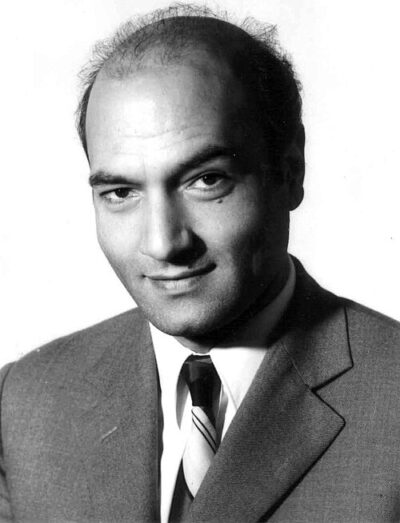
Ali Shariati
Ali Shariati was an Iranian writer, scholar of Islam, and political activist. Born November 23, 1933, in Mazinan. Died June 19, 1977, in Southampton. Known for Hubut in Kavir, Guftuguhaye Tanha’i and Horr. Educated at Faculty of Arts of Paris and Ferdowsi University of Mashhad.
Facts
40 facts · 1 confirmed by two sources · 13 cited · 25 from one source · 1 where the sources disagree
What’s different
- Died: we show June 19, 1977 (Sources disagree). Wikipedia says June 18, 1977
Where this comes from
Papalocal keeps its own record. It started from these sources; what each one said is kept here as it was copied, so a change on their side never changes this page by itself. Tap one to read its version.
What Wikidata says · copied November 16, 2026 · revision 2567383915
- Described as
- Iranian writer, scholar of Islam, and political activist(1933-1977)
- Other names
- Ali Mazinani, Ali Shari'ati, Ali Chariati, Ali Shariati Mazinani
- Born
- November 23, 1933 · 2 references
- Died
- June 19, 1977 · 2 references
- Born in
- Mazinan
- Died in
- Southampton · 1 reference
- Buried in
- Sayyidah Zaynab Mosque
- Cause of death
- attempted murder
- Citizen of
- Iran
- Occupation
- sociologist · 1 reference; essayist; poet; political activist; translator; Islamicist; historian · 1 reference; teacher · 1 reference
- Political party
- Freedom Movement of Iran · 1 reference
- Education
- Faculty of Arts of Paris; Ferdowsi University of Mashhad
- Member of
- Ershad Hussainiya
- Known for
- Hubut in Kavir; Guftuguhaye Tanha’i; Horr; Kavir; Red Shi'ism vs. Black Shi'ism; Fatemeh Is Fatemeh; The Philosophy of Supplication; Ba Mukhatabhaye Ashna
- Field
- Islamism · 1 reference; Shia Islam · 1 reference; Persian literature; socialism · 1 reference; Sufism; Islam
- Spouse
- Pouran Shariat-Razavi · 1 reference
- Children
- Ehsan Shariati · 2 references; Sara Shariati · 1 reference; Susan Shariati · 1 reference
- Father
- Mohammad-Taqi Shariati · 1 reference
- Religion
- Islam
- Website
- http://shariati.com
- Wikipedias with a page
- 53
Wikidata item Q317475 (wikidata.org/wiki/Q317475), public domain (CC0). Copied November 16, 2026.
What Wikipedia says · copied November 16, 2026 · revision 1378966551
Ali Shariati Mazinani (23 November 1933 – 18 June 1977) was an Iranian revolutionary and sociologist who specialised in the sociology of religion. He is regarded as one of the most influential Iranian intellectuals of the 20th century. He has been referred to as the "ideologue of the Islamic Revolution", although his ideas did not ultimately serve as the foundation for the Islamic Republic. The work and ideas associated with Shariati are known as Shariatism, which proposed a progressive interpretation of Shia Islam.
- Born, in its opening lines
- November 23, 1933
- Died, in its opening lines
- June 18, 1977
From the Wikipedia article “Ali Shariati” (en.wikipedia.org/wiki/Ali_Shariati), by its contributors, under CC BY-SA 4.0 (creativecommons.org/licenses/by-sa/4.0/). Copied November 16, 2026; not changed.
Confirmed Two sources agree. Cited One source, and it names where it got it. One source One source, without a reference of its own. Sources disagree The sources disagree. We show the best-supported value and keep theirs below.
