
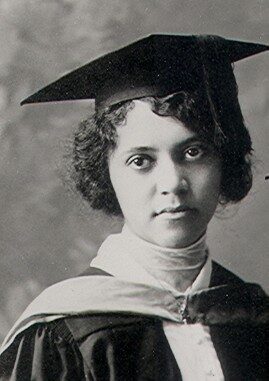
Alice Augusta Ball
Alice Augusta Ball was an African American chemist. Born July 24, 1892, in Seattle. Died December 31, 1916, in Seattle. Known for leprosy. Educated at University of Hawaiʻi System and University of Washington.
Facts
15 facts · 2 confirmed by two sources · 6 cited · 7 from one source
Where this comes from
Papalocal keeps its own record. It started from these sources; what each one said is kept here as it was copied, so a change on their side never changes this page by itself. Tap one to read its version.
What Wikidata says · copied November 13, 2026 · revision 2568544464
- Described as
- African American chemist (1892–1916)
- Born
- July 24, 1892
- Died
- December 31, 1916 · 1 reference
- Born in
- Seattle · 2 references
- Died in
- Seattle · 1 reference
- Cause of death
- chlorine exposure · 2 references
- Citizen of
- United States
- Occupation
- chemist; pharmacist · 1 reference
- Worked for
- University of Hawaiʻi System · 1 reference
- Education
- University of Hawaiʻi System · 1 reference; University of Washington · 2 references; Broadway High School · 1 reference
- Known for
- leprosy
- Field
- chemistry · 1 reference
- Lived in
- Oahu · 1 reference
- Wikipedias with a page
- 44
Wikidata item Q16059113 (wikidata.org/wiki/Q16059113), public domain (CC0). Copied November 13, 2026.
What Wikipedia says · copied November 13, 2026 · revision 1379016490
Alice Augusta Ball (July 24, 1892 – December 31, 1916) was a Black American chemist whose groundbreaking work produced the first effective treatment for Hansen's disease, better known as leprosy. She was born in Seattle, Washington, to James Presley Ball Jr. and Laura Louise Ball. Her father was a photographer, journalist, and lawyer, while her mother left a photography career to raise the family. Ball excelled academically, graduating from Seattle High School with strong interests in the sciences.
She continued her education at the University of Washington, earning a pharmaceutical chemistry degree in 1912 and a bachelor's degree in pharmacy in 1914. During her studies, she co-authored a research paper on benzoylation reactions published in the Journal of the American Chemical Society, making her one of the first Black American women to publish in a major scientific journal. Ball earned a scholarship to the College of Hawaiʻi (now University of Hawaiʻi), where she completed a master's degree in chemistry in 1915, becoming the first woman and first Black American to achieve the degree, and was subsequently appointed as the college's first female chemistry instructor.
While working in Hawaiʻi, Ball was approached by Harry T. Hollmann of the Leprosy Investigation Station, who sought help improving the therapeutic use of chaulmoogra oil, a traditional but highly ineffective treatment for leprosy. The disease carried a severe stigma, with patients often being forcibly isolated in remote settlements with horrible conditions. Though chaulmoogra oil had shown potential for centuries, its extreme viscosity and poor absorption made it nearly impossible to administer effectively. Ingested doses caused nausea and vomiting, while injectable forms caused painful lesions under the skin.
Ball's critical innovation was developing a method to chemically modify chaulmoogra oil's fatty acids into ethyl esters, making the compound water-soluble and suitable for injection. This process, later called the "Ball Method," allowed the drug to be absorbed into the bloodstream safely and efficiently, overcoming the problems that had prevented earlier use. By 1920, health authorities in Hawaiʻi reported that many patients who received the Ball Method were able to return home, rather than remain in lifelong quarantine.
Ball died unexpectedly in 1916 at age 24 before she could publish her findings. After her death, others took credit for her work, but later scholarship and institutional recognition restored her legacy. The Ball Method itself became medically obsolete after the 1946 development of a monotherapy using dapsone. The technique is historically significant, marking a turning point between early botanical medicine and modern pharmaceutical chemistry. Ball's innovation improved medical outcomes for thousands of patients worldwide.
- Born, in its opening lines
- July 24, 1892
- Died, in its opening lines
- December 31, 1916
From the Wikipedia article “Alice Ball” (en.wikipedia.org/wiki/Alice_Ball), by its contributors, under CC BY-SA 4.0 (creativecommons.org/licenses/by-sa/4.0/). Copied November 13, 2026; not changed.
Confirmed Two sources agree. Cited One source, and it names where it got it. One source One source, without a reference of its own. Sources disagree The sources disagree. We show the best-supported value and keep theirs below.
