
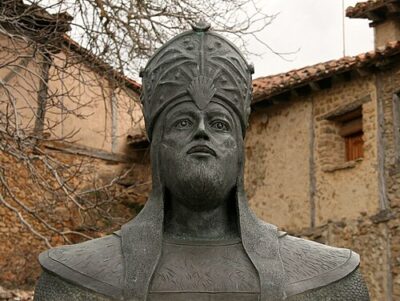
Almanzor
Almanzor was an Arab Andalusian military leader and statesman (c.938-1002). Born August 18, 938, in Algeciras. Died August 9, 1002, in Medinaceli. Positions held include hajib (978–1002).
Facts
16 facts · 1 confirmed by two sources · 2 cited · 11 from one source · 2 where the sources disagree
What’s different
- Died: we show August 9, 1002 (Sources disagree). Wikipedia says August 8, 1002
- Born in: we show Algeciras (Sources disagree). Wikidata also lists Umayyad Caliphate
Where this comes from
Papalocal keeps its own record. It started from these sources; what each one said is kept here as it was copied, so a change on their side never changes this page by itself. Tap one to read its version.
What Wikidata says · copied November 16, 2026 · revision 2567877914
- Described as
- Arab Andalusian military leader and statesman (c.938-1002)
- Other names
- Abu Mohammed Almansur
- Born
- August 18, 938 · 1 reference
- Died
- August 9, 1002 · 2 references
- Born in
- Algeciras · 1 reference; Umayyad Caliphate
- Died in
- Medinaceli · 1 reference
- Buried in
- Medinaceli
- Occupation
- politician; military personnel; military commander · 1 reference
- Positions held
- hajib (978–1002)
- Spouse
- الذلفاء (983–); Asma Bint Ghalib (978–); Oneca of Castile
- Children
- Abd al-Rahman Sanchuelo; Abd al-Malik al-Muzaffar
- Religion
- Sunni Islam · 1 reference
- Lived in
- Al-Madinat al-Zahira
- Wikipedias with a page
- 38
Wikidata item Q334861 (wikidata.org/wiki/Q334861), public domain (CC0). Copied November 16, 2026.
What Wikipedia says · copied November 16, 2026 · revision 1384819433
Abu ʿAmer Muḥammad ibn ʿAbdullāh ibn Abi ʿAmer al-Maʿafiri (Arabic: أبو عامر محمد بن عبد الله بن أبي عامر المعافري), nicknamed al-Manṣūr (Arabic: المنصور, "the Victorious"), which is often Latinized as Almanzor in Spanish, Almansor in Catalan and Almançor in Portuguese (c. 938 – 8 August 1002), was a Muslim Arab Andalusi military leader and statesman. As the chancellor of the Umayyad Caliphate of Córdoba and hajib (chamberlain) for Caliph Hisham II, Almanzor was effectively ruler of Islamic Iberia.
Born in Turrush to a family of Yemeni Arab origin with some juridical ancestors, ibn Abi ʿĀmir left for Córdoba when still young to be trained as a faqīh. After a few humble beginnings, he joined the court administration and soon gained the confidence of Subh, mother of the children of Caliph Al-Hakam II. Thanks to her patronage and his own efficiency, he quickly expanded his role.
During the caliphate of Al-Hakam II, he held several important administrative positions, including director of the mint (967), administrator for Subh and her children, administrator for intestate inheritances, and quartermaster for the army of General Ghalib ibn Abd al-Rahman (973). The death of the caliph in 976 marked the beginning of the domination of the Caliphate by this functionary, which continued beyond his death with the government of two of his sons, Abd al-Malik al-Muzaffar and Abd al-Rahman Sanchuelo, up to 1009. As chamberlain of the caliphate (from 978), he exercised extraordinary power in the al-Andalus state, throughout the Iberian Peninsula and in part of the Maghreb, while Caliph Hisham II was reduced to near-figurehead status.
His portentous rise to power has been explained by an insatiable thirst for dominance, but historian Eduardo Manzano Moreno warns that "it must be understood within the framework of the complex internal struggles that developed within the Umayyad administration." Deeply religious, he received the pragmatic support of Muslim authorities for his control of political power, though not without periodic tensions between them. The basis of his power was his defense of jihad, which he proclaimed in the name of the Caliph. His image as a champion of Islam served to justify his assumption of governmental authority.
Having monopolized political dominance in the caliphate, he carried out profound reforms in both foreign and domestic politics. He made numerous victorious campaigns in both the Maghreb and Iberia. On the peninsula, his bloody and very destructive incursions against the Christian kingdoms temporarily halted their advance southward.
- Born, in its opening lines
- c. 938
- Died, in its opening lines
- August 8, 1002
From the Wikipedia article “Almanzor” (en.wikipedia.org/wiki/Almanzor), by its contributors, under CC BY-SA 4.0 (creativecommons.org/licenses/by-sa/4.0/). Copied November 16, 2026; not changed.
Confirmed Two sources agree. Cited One source, and it names where it got it. One source One source, without a reference of its own. Sources disagree The sources disagree. We show the best-supported value and keep theirs below.
