
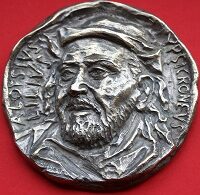
Aloysius Lilius
Aloysius Lilius was an Italian astronomer. Born 1510, in Cirò. Died 1576, in Rome.
Facts
18 facts · 2 confirmed by two sources · 1 cited · 15 from one source
Where this comes from
Papalocal keeps its own record. It started from these sources; what each one said is kept here as it was copied, so a change on their side never changes this page by itself. Tap one to read its version.
What Wikidata says · copied November 16, 2026 · revision 2570027669
- Described as
- Italian astronomer
- Born
- 1510 · 4 references
- Died
- 1576 · 1 reference
- Born in
- Cirò
- Died in
- Rome
- Occupation
- philosopher; astronomer · 1 reference; university teacher; mathematician · 1 reference; physician · 1 reference; physicist
- Worked for
- University of Perugia
- Field
- medicine; physician; philosopher; chronology; astronomy; astronomer · 1 reference
- Religion
- Catholic Church
- Wikipedias with a page
- 35
Wikidata item Q436097 (wikidata.org/wiki/Q436097), public domain (CC0). Copied November 16, 2026.
What Wikipedia says · copied November 16, 2026 · revision 1377290892
Aloysius Lilius (c. 1510 – 1576), also variously referred to as Luigi Lilio or Luigi Giglio, was an Italian physician, astronomer, philosopher and chronologist, and also the "primary author" who provided the proposal that (after modifications) became the basis of the Gregorian Calendar reform of 1582.
The crater Lilius on the Moon is named after him, as is the asteroid 2346 Lilio. In computer science, the Lilian date is the number of days since the adoption of the Gregorian calendar on 15 October 1582.
- Born, in its opening lines
- 1510
- Died, in its opening lines
- 1576
From the Wikipedia article “Aloysius Lilius” (en.wikipedia.org/wiki/Aloysius_Lilius), by its contributors, under CC BY-SA 4.0 (creativecommons.org/licenses/by-sa/4.0/). Copied November 16, 2026; not changed.
Confirmed Two sources agree. Cited One source, and it names where it got it. One source One source, without a reference of its own. Sources disagree The sources disagree. We show the best-supported value and keep theirs below.
