
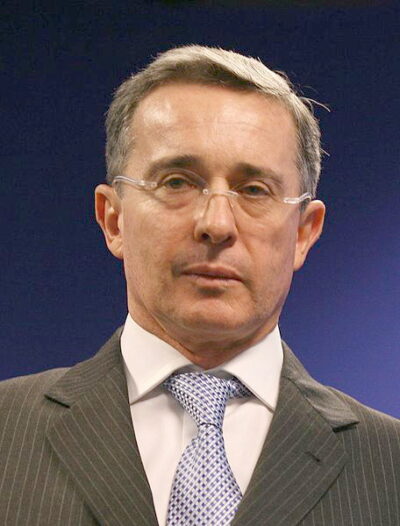
Álvaro Uribe Vélez
Álvaro Uribe Vélez is the 39.º President of Colombia from 2002 to 2010. Born July 4, 1952, in Medellín. Positions held include President of Colombia (2002–2010), member of the Senate of Colombia (2014–) and Governor of Antioquia (1995–1998). Educated at Harvard Law School and St Antony's College. Awards include Collar of the Order of Isabella the Catholic, Presidential Medal of Freedom and Golden Plate Award.
Facts
32 facts · 1 confirmed by two sources · 10 cited · 21 from one source
Where this comes from
Papalocal keeps its own record. It started from these sources; what each one said is kept here as it was copied, so a change on their side never changes this page by itself. Tap one to read its version.
What Wikidata says · copied November 16, 2026 · revision 2567461039
- Described as
- 39.º President of Colombia from 2002 to 2010
- Other names
- Álvaro Uribe, Uribe
- Born
- July 4, 1952 · 6 references
- Born in
- Medellín · 1 reference
- Citizen of
- Colombia
- Occupation
- lawyer; writer · 1 reference; politician · 2 references; jurist · 1 reference
- Positions held
- President of Colombia (2002–2010); member of the Senate of Colombia (2014–) · 2 references; Governor of Antioquia (1995–1998) · 1 reference; mayor of Medellín (1982) · 1 reference
- Political party
- Centro Democrático (2013–) · 1 reference; Colombian Liberal Party (1997–2001); Colombia First (2002–2010); Union Party for the People (2010–2013)
- Worked for
- Georgetown University
- Education
- Harvard Law School; St Antony's College; Harvard Extension School; University of Antioquia; Harvard University
- Awards
- Collar of the Order of Isabella the Catholic (2005) · 1 reference; Presidential Medal of Freedom (2009) · 1 reference; Golden Plate Award; honorary doctor of the Peking University (2005) · 1 reference; Medal of the Oriental Republic of Uruguay (2003) · 1 reference; Xavier Villaurrutia Award (2014) · 1 reference
- Spouse
- Lina María Moreno Mejía (1979–) · 1 reference
- Children
- Tomás Uribe
- Father
- Alberto Uribe Sierra
- Religion
- Catholicism
- Website
- https://alvarouribevelez.com.co
- Wikipedias with a page
- 60
Wikidata item Q187413 (wikidata.org/wiki/Q187413), public domain (CC0). Copied November 16, 2026.
What Wikipedia says · copied November 16, 2026 · revision 1382691496
Álvaro Uribe Vélez (born 4 July 1952) is a Colombian politician who served as the 32nd President of Colombia from 7 August 2002 to 7 August 2010. He is a member and leader of the right-wing political party Democratic Center.
Uribe began his political career in his home department of Antioquia. He held offices in the Public Enterprises of Medellín and in the Ministry of Labor, and directed the Special Administrative Unit of Civil Aeronautics (1980–1982). He became the Mayor of Medellín in October 1982. He served as a senator between 1986 and 1994, and as the Governor of Antioquia between 1995 and 1997, before being elected President of Colombia in 2002.
Following his 2002 election, Uribe led an all-out military offensive against terrorist groups such as the FARC and the ELN with funding and backing from the Clinton and Bush administrations in the form of a US$2.8 billion direct foreign aid package called "Plan Colombia". He also led an effort to demobilize the right-wing paramilitary group known as the AUC. His defense minister Juan Manuel Santos played a significant role in his administration and oversaw large-scale alleged executions, by which thousands of civilians were killed by the Colombian army, as part of the "false positives" scandal, with almost total impunity. Their deaths are being investigated by the United Nations.
In August 2010, Uribe was appointed vice-chairman of the UN panel investigating the Gaza flotilla raid. In 2012 Uribe and a group of political allies founded the right-wing Democratic Center movement to contest the 2014 national elections. He was elected senator in the 2014 parliamentary election and took office in July 2014. Uribe was critical of his successor Juan Manuel Santos's efforts to appease the FARC terrorists.
In August 2020, the Supreme Court of Justice of Colombia ordered his arrest as part of an investigation into bribery and witness tampering. The case went to the Attorney General, after which Uribe resigned from his Senate seat. He was convicted on 28 July 2025, but this was overturned on appeal in October 2025.
Uribe oversaw democratic backsliding in Colombia during his presidency. A number of his political opponents have claimed for years that he ought to be prosecuted, alleging that he has ties with paramilitarism.
- Born, in its opening lines
- July 4, 1952
From the Wikipedia article “Álvaro Uribe” (en.wikipedia.org/wiki/Álvaro_Uribe), by its contributors, under CC BY-SA 4.0 (creativecommons.org/licenses/by-sa/4.0/). Copied November 16, 2026; not changed.
Confirmed Two sources agree. Cited One source, and it names where it got it. One source One source, without a reference of its own. Sources disagree The sources disagree. We show the best-supported value and keep theirs below.
