
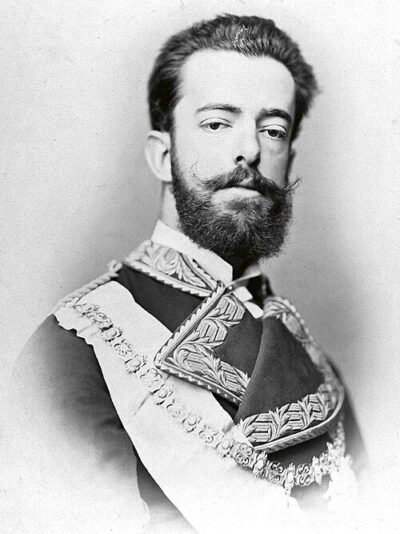
Amadeo I of Spain
Amadeo I of Spain was an Italian Royal and temporary Head of State of Spain. Born May 30, 1845, in Turin. Died January 18, 1890, in Turin. Positions held include Monarch of Spain (1870–1873) and Head of State of Spain (1870–1873). Awards include Order of the Black Eagle, Order of St. Andrew and Knight of the Order of Saints Maurice and Lazarus.
Facts
33 facts · 2 confirmed by two sources · 18 cited · 13 from one source
Where this comes from
Papalocal keeps its own record. It started from these sources; what each one said is kept here as it was copied, so a change on their side never changes this page by itself. Tap one to read its version.
What Wikidata says · copied November 16, 2026 · revision 2568882129
- Described as
- Italian Royal and temporary Head of State of Spain (1845–1890)
- Other names
- Prince Amedeo Ferdinando Maria of Savoy, Amedeo Ferdinando Maria di Savoia, Prince Amedeo of Savoy, Amedeo di Savoia, Amadeus I, Prince Amedeo, 1st Duke of Aosta
- Born
- May 30, 1845 · 7 references
- Died
- January 18, 1890 · 7 references
- Born in
- Turin · 2 references
- Died in
- Turin · 3 references
- Buried in
- Basilica of Superga · 1 reference
- Cause of death
- bronchopneumonia · 1 reference
- Citizen of
- Kingdom of Italy (1861–); Spain
- Occupation
- sovereign · 1 reference; military personnel
- Positions held
- Monarch of Spain (1870–1873); Head of State of Spain (1870–1873)
- Awards
- Order of the Black Eagle; Order of St. Andrew; Knight of the Order of Saints Maurice and Lazarus; Knight Grand Cross in the Order of the Netherlands Lion (1863) · 1 reference; Knight of the Order of the Elephant (1863)
- Spouse
- Maria Vittoria dal Pozzo (1867–1876) · 2 references; Princess Maria Letizia, Duchess of Aosta (1888–1890) · 2 references
- Children
- Prince Emanuele Filiberto, 2nd Duke of Aosta · 1 reference; Prince Vittorio Emanuele, Count of Turin · 1 reference; Prince Luigi Amedeo, Duke of the Abruzzi · 1 reference; Prince Umberto, Count of Salemi · 1 reference
- Father
- Victor Emmanuel II of Italy · 1 reference
- Mother
- Archduchess Adelaide of Austria · 1 reference
- Siblings
- Maria Pia of Savoy · 1 reference; Princess Maria Clotilde of Savoy · 1 reference; Umberto I of Italy · 1 reference; Prince Oddone, Duke of Montferrat · 1 reference; Vittorio Emanuele di Savoia-Carignano; Carlo Alberto di Savoia-Carignano, Principe di Savoia
- Religion
- Catholicism
- Military rank
- Capitán General de la Real Armada Española
- Wikipedias with a page
- 63
Wikidata item Q32432 (wikidata.org/wiki/Q32432), public domain (CC0). Copied November 16, 2026.
What Wikipedia says · copied November 16, 2026 · revision 1385894728
Amadeo I (Italian: Amedeo Ferdinando Maria di Savoia; 30 May 1845 – 18 January 1890), also known as Amadeus, was an Italian prince who reigned as King of Spain from 1870 to 1873. The only king of Spain to come from the House of Savoy, he was the second son of Victor Emmanuel II of Italy and was known for most of his life as the Duke of Aosta, the usual title for a second son in the Savoyard dynasty.
He was elected by the Cortes Generales as Spain's monarch in 1870, following the deposition of Isabella II, and was sworn in the following year. Amadeo's reign was fraught with growing republicanism, Carlist rebellions in the north, the assassination of Prime Minister Juan Prim and the Cuban independence movement. After three tumultuous years on the throne, he abdicated and returned to Italy in 1873, and the First Spanish Republic was declared as a result.
He founded the Aosta branch of Italy's royal House of Savoy, which is junior in agnatic descent to the branch descended from King Umberto I that reigned in Italy until 1946, but senior to the branch of the dukes of Genoa.
- Born, in its opening lines
- May 30, 1845
- Died, in its opening lines
- January 18, 1890
From the Wikipedia article “Amadeo I of Spain” (en.wikipedia.org/wiki/Amadeo_I_of_Spain), by its contributors, under CC BY-SA 4.0 (creativecommons.org/licenses/by-sa/4.0/). Copied November 16, 2026; not changed.
Confirmed Two sources agree. Cited One source, and it names where it got it. One source One source, without a reference of its own. Sources disagree The sources disagree. We show the best-supported value and keep theirs below.
