
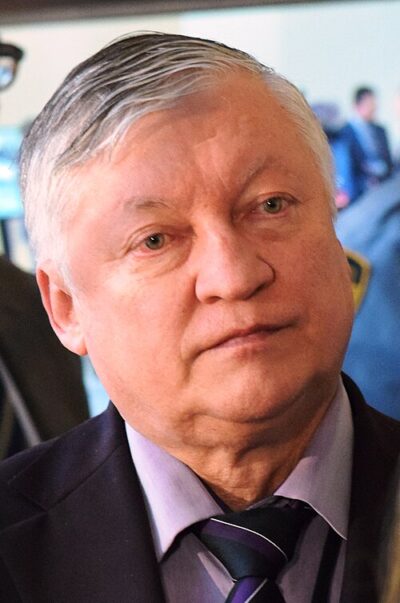
Anatoly Karpov
Anatoly Karpov is a Russian chess player. Born May 23, 1951, in Zlatoust. Positions held include member of the State Duma (2011–). Educated at Saint Petersburg State University. Awards include world chess champion, Order of Lenin and Chess Oscar (9 times).
Facts
36 facts · 1 confirmed by two sources · 5 cited · 30 from one source
Where this comes from
Papalocal keeps its own record. It started from these sources; what each one said is kept here as it was copied, so a change on their side never changes this page by itself. Tap one to read its version.
What Wikidata says · copied November 16, 2026 · revision 2565576773
- Described as
- Russian chess player
- Other names
- Anatoly Yevgenyevich Karpov
- Born
- May 23, 1951 · 9 references
- Born in
- Zlatoust · 2 references
- Citizen of
- Soviet Union (1951–1991); Russia (1991–)
- Occupation
- chess player · 1 reference; politician; writer; journalist; Grandmaster · 1 reference; athlete · 1 reference
- Positions held
- member of the State Duma (2011–)
- Political party
- Communist Party of the Soviet Union
- Worked for
- Saint Petersburg State University
- Education
- Saint Petersburg State University
- Member of
- 6th State Duma of the Russian Federation; 7th State Duma of the Russian Federation; first Civic Chamber of the Russian Federation; 8th State Duma of the Russian Federation; 9th State Duma of the Russian Federation
- Sport
- chess
- Awards
- world chess champion (1975–1985); Order of Lenin (1981); Chess Oscar (9 times) (1973, 1974, 1975, 1976, 1977, 1979, 1980, 1981, 1984); Order "For Merit to the Fatherland", 3rd class (2001); Order of the Red Banner of Labour (1978) · 1 reference; Order of Friendship (2011); Order of Merit (Ukraine), 3rd class; Order of Merit (Ukraine), 2nd class; Order of St. Sergius of Radonezh 2nd class; Honoured Master of Sports of the USSR (1974); Order of Holy Prince Daniel of Moscow 2nd class; Medal for Strengthening the Penal Enforcement System; Order of May · 1 reference; Silver Olympic Order (2001) · 1 reference; Order "For Merit to the Fatherland", 2nd class (2021) · 1 reference
- Website
- http://aekarpov.com/
- Wikipedias with a page
- 90
Wikidata item Q131674 (wikidata.org/wiki/Q131674), public domain (CC0). Copied November 16, 2026.
What Wikipedia says · copied November 16, 2026 · revision 1373863393
Anatoly Yevgenyevich Karpov (Russian: Анатолий Евгеньевич Карпов, IPA: [ɐnɐˈtolʲɪj jɪvˈɡʲenʲjɪvʲɪtɕ ˈkarpəf]; born May 23, 1951) is a Russian and former Soviet chess grandmaster, former World Chess Champion, and politician. He was the 12th World Chess Champion, from 1975 to 1985, a three-time FIDE World Champion (1993, 1996, 1998), twice World Chess champion as a member of the USSR team (1985, 1989), a six-time winner of Chess Olympiads as a member of the USSR team (1972, 1974, 1980, 1982, 1986, 1988), and the 1st World Rapid Chess Champion (1988). The International Association of Chess Press awarded him nine Chess Oscars (1973–77, 1979, 1980, 1981, 1984).
For 25 consecutive years (1974–1998), Karpov was either the world champion (16 years in total) or a world championship challenger, a record surpassed only by Emanuel Lasker. Karpov's chess tournament successes include over 160 first-place finishes. He had a peak Elo rating of 2780, and his 102 total months world number one is the third-longest of all time, behind Magnus Carlsen and Garry Kasparov. Karpov is also an elected Member of the State Duma in Russia. Since 2006, he has chaired the Commission for Ecological Safety and Environmental Protection of the Civic Chamber of the Russian Federation, and since 2007 he has been a member of the Public Council under the Ministry of Defence. He is currently the oldest living World Chess Champion.
- Born, in its opening lines
- May 23, 1951
From the Wikipedia article “Anatoly Karpov” (en.wikipedia.org/wiki/Anatoly_Karpov), by its contributors, under CC BY-SA 4.0 (creativecommons.org/licenses/by-sa/4.0/). Copied November 16, 2026; not changed.
Confirmed Two sources agree. Cited One source, and it names where it got it. One source One source, without a reference of its own. Sources disagree The sources disagree. We show the best-supported value and keep theirs below.
