
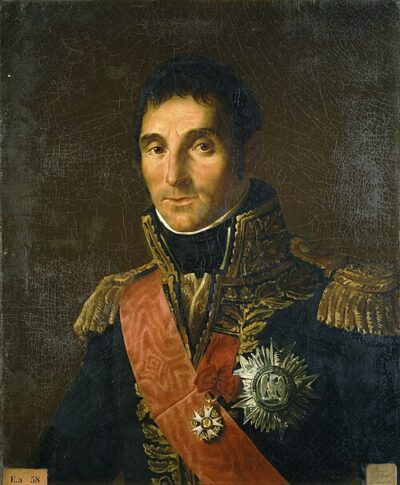
André Masséna
André Masséna was a French military commander during the Revolutionary and Napoleonic Wars. Born May 6, 1758, in Nice. Died April 4, 1817, in Paris. Positions held include député au Corps législatif (1803–1807), Mayor of Nice and Peer of France. Awards include Grand Cross of the Legion of Honour, Marshal of the Empire and Knight Commander of the Order of Saint Louis.
Facts
30 facts · 2 confirmed by two sources · 5 cited · 22 from one source · 1 where the sources disagree
What’s different
- Buried in: we show Père Lachaise Cemetery (Sources disagree). Wikidata also lists Grave of Masséna
Where this comes from
Papalocal keeps its own record. It started from these sources; what each one said is kept here as it was copied, so a change on their side never changes this page by itself. Tap one to read its version.
What Wikidata says · copied November 16, 2026 · revision 2560203407
- Described as
- French military commander during the Revolutionary and Napoleonic Wars (1758-1817)
- Other names
- Andre Massena, Andrea Massena
- Born
- May 6, 1758 · 10 references
- Died
- April 4, 1817 · 11 references
- Born in
- Nice · 2 references
- Died in
- Paris · 3 references
- Buried in
- Père Lachaise Cemetery; Grave of Masséna
- Cause of death
- tuberculosis
- Name at birth
- Andrea Massena
- Citizen of
- France (1814–)
- Occupation
- politician; military personnel · 1 reference
- Positions held
- député au Corps législatif (1803–1807) · 1 reference; Mayor of Nice; Peer of France
- Awards
- Grand Cross of the Legion of Honour (1805–); Marshal of the Empire (1804–); Knight Commander of the Order of Saint Louis; Marshal of France; list of names inscribed on the Arc de Triomphe; Knight Grand Cross of the Order of Saint Stephen of Hungary; Order of the Iron Crown (Kingdom of Italy) · 1 reference; Order of Saint Hubert · 1 reference; Merit Order of the Bavarian Crown · 1 reference; Order of Ludwig I · 1 reference; Order of Fidelity · 1 reference; Order of Christ · 1 reference
- Children
- Victoire Thècle Masséna; Francois Victor Massena, 2nd Duke of Rivoli
- Religion
- Catholicism · 1 reference
- Military branch
- infantry
- Military rank
- general
- Wikipedias with a page
- 50
Wikidata item Q242609 (wikidata.org/wiki/Q242609), public domain (CC0). Copied November 16, 2026.
What Wikipedia says · copied November 16, 2026 · revision 1379809435
André Masséna, prince d'Essling, duc de Rivoli (English: mass-eh-NAH, French: [ɑ̃dʁe massena]; born Andrea Massena; 6 May 1758 – 4 April 1817), was a French military commander of the French Revolutionary Wars and the Napoleonic Wars. He was one of the original eighteen Marshals of the Empire created by Napoleon I, who nicknamed him "the dear child of victory" (l'enfant chéri de la victoire). He is considered to be one of the greatest generals of the Revolutionary and Napoleonic Wars.
Beginning his career as an enlisted soldier under the ancien régime, Masséna established himself as one of the best generals of the French Republic during the French Revolutionary Wars. He served as Napoleon Bonaparte's main lieutenant in the Italian campaign of the War of the First Coalition, playing a decisive role in the victories of Arcole and Rivoli, and was at the helm of the advance into Austrian territory that compelled them to open peace negotiations. In 1799, Masséna defeated the Second Coalition forces at the Second Battle of Zurich, which had considerable strategic repercussions for France.
Under the French Empire, Masséna continued to demonstrate great competence in his various commands, both under Napoleon's direct orders and at the head of independent forces in secondary fronts. He campaigned in Italy once again in 1805, invaded the Kingdom of Naples in 1806 and played a major role at the battles of Aspern-Essling and Wagram in 1809. Masséna was rewarded by Napoleon with the titles of Duke of Rivoli (duc de Rivoli) and Prince of Essling (prince d'Essling). However, his failed invasion of Portugal in 1810 earned him the disgrace of the Emperor, who no longer appointed him to any major commands during the Empire. Having rallied to the Bourbon Restoration, Masséna died in Paris shortly afterwards at the age of 58.
Although many of Napoleon's generals were trained at the finest French and European military academies, Masséna was among those who achieved greatness without the benefit of formal education. While those of noble rank acquired their education and promotions as a matter of privilege, Masséna rose from humble origins to such prominence that Napoleon referred to him as "the greatest name of my military empire". In addition to his battlefield successes, Masséna's leadership aided the careers of many. A majority of the French marshals of the time served under his command at some point.
- Born, in its opening lines
- May 6, 1758
- Died, in its opening lines
- April 4, 1817
From the Wikipedia article “André Masséna” (en.wikipedia.org/wiki/André_Masséna), by its contributors, under CC BY-SA 4.0 (creativecommons.org/licenses/by-sa/4.0/). Copied November 16, 2026; not changed.
Confirmed Two sources agree. Cited One source, and it names where it got it. One source One source, without a reference of its own. Sources disagree The sources disagree. We show the best-supported value and keep theirs below.
