
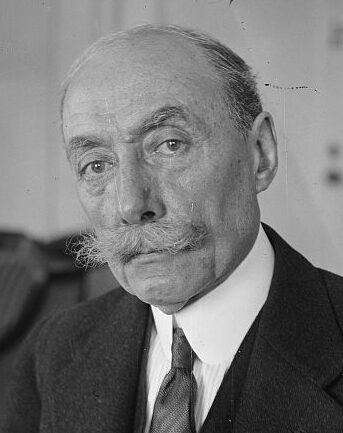
André Messager
André Messager was a French opera composer and conductor. Born December 30, 1853, in Montluçon. Died February 24, 1929, in 17th arrondissement of Paris. Educated at Niedermeyer school in Paris. Awards include Commander of the Legion of Honour.
Facts
18 facts · 2 confirmed by two sources · 6 cited · 10 from one source
Where this comes from
Papalocal keeps its own record. It started from these sources; what each one said is kept here as it was copied, so a change on their side never changes this page by itself. Tap one to read its version.
What Wikidata says · copied November 17, 2026 · revision 2544931951
- Described as
- French opera composer and conductor (1853–1929)
- Other names
- Andre Messager
- Born
- December 30, 1853 · 10 references
- Died
- February 24, 1929 · 9 references
- Born in
- Montluçon · 1 reference
- Died in
- 17th arrondissement of Paris
- Buried in
- Passy Cemetery
- Citizen of
- France
- Occupation
- conductor · 2 references; composer · 1 reference; choreographer; music director; organist · 2 references; music arranger · 1 reference
- Education
- Niedermeyer school in Paris
- Member of
- Académie des beaux-arts
- Genre
- opera
- Instrument
- organ
- Awards
- Commander of the Legion of Honour
- Spouse
- Hope Temple (1895–1929) · 1 reference
- Wikipedias with a page
- 25
Wikidata item Q457645 (wikidata.org/wiki/Q457645), public domain (CC0). Copied November 17, 2026.
What Wikipedia says · copied November 17, 2026 · revision 1377701584
André Charles Prosper Messager (French: [mɛsaʒe]; 30 December 1853 – 24 February 1929) was a French composer, organist, pianist and conductor. His compositions include eight ballets and thirty opéras comiques, opérettes and other stage works, among which his ballet Les Deux Pigeons (1886) and opéra comique Véronique (1898) have had lasting success; Les p'tites Michu (1897) and Monsieur Beaucaire (1919) were also popular internationally.
Messager took up the piano as a small child and later studied composition with, among others, Camille Saint-Saëns and Gabriel Fauré. He became a major figure in the musical life of Paris and later London, both as a conductor and a composer. Many of his Parisian works were also produced in the West End and some on Broadway; the most successful had long runs and numerous international revivals. He wrote two operatic works in English, and his later output included musical comedies for Sacha Guitry and Yvonne Printemps.
As a conductor, Messager held prominent positions in Paris and London, at the head of the Opéra-Comique, the Paris Opéra, the Orchestre de la Société des Concerts du Conservatoire, and the Royal Opera House, Covent Garden. Although as a composer he is known chiefly for his light works, as a conductor he presented a wide range of operas, from Mozart to Richard Strauss, and he acquired a reputation as a conductor of Wagner. In Paris he conducted the world premieres of Debussy's Pelléas et Mélisande, Massenet's Grisélidis and Charpentier's Louise. At Covent Garden, he gave the British premieres of operas by Saint-Saëns and Massenet.
Messager's music became known for its melodic and orchestral invention, musical craftsmanship, and characteristically French elegance and grace. Although most of his works have been infrequently revived, historians of music consider him the last major figure in French opéra comique and opérette.
- Born, in its opening lines
- December 30, 1853
- Died, in its opening lines
- February 24, 1929
From the Wikipedia article “André Messager” (en.wikipedia.org/wiki/André_Messager), by its contributors, under CC BY-SA 4.0 (creativecommons.org/licenses/by-sa/4.0/). Copied November 17, 2026; not changed.
Confirmed Two sources agree. Cited One source, and it names where it got it. One source One source, without a reference of its own. Sources disagree The sources disagree. We show the best-supported value and keep theirs below.
