
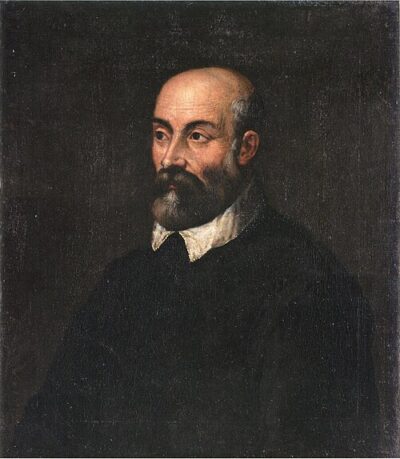
Andrea Palladio
Andrea Palladio was an Italian architect. Born November 30, 1508, in Padua. Died August 19, 1580, in Vicenza. Known for Basilica Palladiana, Gallerie dell'Accademia and Villa Saraceno.
Facts
21 facts · 2 confirmed by two sources · 4 cited · 14 from one source · 1 where the sources disagree
What’s different
- Died in: we show Vicenza (Sources disagree). Wikidata also lists Maser
Where this comes from
Papalocal keeps its own record. It started from these sources; what each one said is kept here as it was copied, so a change on their side never changes this page by itself. Tap one to read its version.
What Wikidata says · copied November 16, 2026 · revision 2569401285
- Described as
- Italian architect (1508–1580)
- Other names
- Andrea di Pietro, A. Palladio, Palladio, Andrea di Pietro della Gondola Palladio, André Palladio, Andrea di Pietro della Gondola
- Born
- November 30, 1508 · 2 references
- Died
- August 19, 1580 · 3 references
- Born in
- Padua · 3 references
- Died in
- Vicenza · 4 references; Maser
- Buried in
- major cemetery of Vicenza · 1 reference
- Name at birth
- Andrea di Pietro della Gondola
- Citizen of
- Republic of Venice
- Occupation
- architect · 3 references; art theorist · 1 reference
- Member of
- Accademia delle Arti del Disegno
- Known for
- Basilica Palladiana; Gallerie dell'Accademia; Villa Saraceno; Villa Almerico Capra (La Rotonda); Gioiello di Vicenza; Church of San Giorgio Maggiore · 1 reference; Olympic Theatre; City of Vicenza and the Palladian Villas of the Veneto; Valmarana chapel · 1 reference
- Field
- architecture · 1 reference
- Spouse
- Allegradonna
- Wikipedias with a page
- 79
Wikidata item Q177692 (wikidata.org/wiki/Q177692), public domain (CC0). Copied November 16, 2026.
What Wikipedia says · copied November 16, 2026 · revision 1376480162
Andrea Palladio ( pə-LAH-dee-oh; Italian: [anˈdrɛːa palˈlaːdjo]; Venetian: Andrea Paładio; Padova, 30 November 1508 – 19 August 1580) was an Italian Renaissance architect active in the Venetian Republic. Palladio, influenced by Roman and Greek architecture, primarily Vitruvius, is widely considered to be one of the most influential individuals in the history of architecture. While he designed churches and palaces, he was best known for country houses and villas. His teachings, summarized in the architectural treatise, The Four Books of Architecture, gained him wide recognition.
The city of Vicenza, with its 23 buildings designed by Palladio, and his 24 villas in the Veneto are listed by UNESCO as part of a World Heritage Site named City of Vicenza and the Palladian Villas of the Veneto. The churches of Palladio are to be found within the "Venice and its Lagoon" UNESCO World Heritage Site.
- Born, in its opening lines
- November 30, 1508
- Died, in its opening lines
- August 19, 1580
From the Wikipedia article “Andrea Palladio” (en.wikipedia.org/wiki/Andrea_Palladio), by its contributors, under CC BY-SA 4.0 (creativecommons.org/licenses/by-sa/4.0/). Copied November 16, 2026; not changed.
Confirmed Two sources agree. Cited One source, and it names where it got it. One source One source, without a reference of its own. Sources disagree The sources disagree. We show the best-supported value and keep theirs below.
