
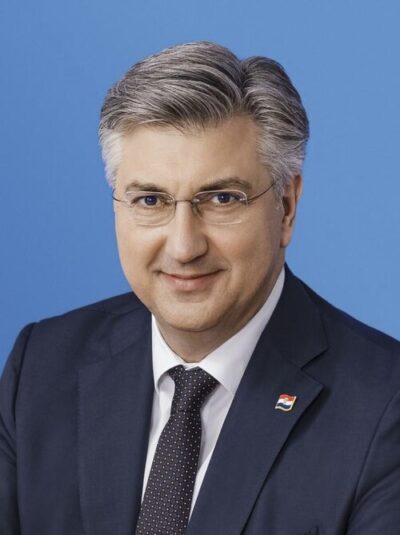
Andrej Plenković
Andrej Plenković is a Prime Minister of Croatia since 2016. Born April 8, 1970, in Zagreb. Positions held include Member of the European Parliament (2013–2016), representative in the Croatian Parliament (2 times) (2011–) and Prime Minister of Croatia (2016–). Educated at Faculty of Law of the University of Zagreb and XVI Gymnasium Zagreb. Awards include Order of Merit (Ukraine), 3rd class, Order of Merit, 1st class and Order of Prince Yaroslav the Wise, 1st class.
Facts
19 facts · 1 confirmed by two sources · 4 cited · 14 from one source
Where this comes from
Papalocal keeps its own record. It started from these sources; what each one said is kept here as it was copied, so a change on their side never changes this page by itself. Tap one to read its version.
What Wikidata says · copied November 16, 2026 · revision 2567659914
- Described as
- Prime Minister of Croatia since 2016
- Other names
- Andrej Plenkovic
- Born
- April 8, 1970 · 2 references
- Born in
- Zagreb · 1 reference
- Citizen of
- Croatia
- Occupation
- politician · 2 references; diplomat
- Positions held
- Member of the European Parliament (2013–2016); representative in the Croatian Parliament (2 times) (2011–); Prime Minister of Croatia (2016–) · 1 reference; First Councilor (2005–2011)
- Political party
- Croatian Democratic Union
- Education
- Faculty of Law of the University of Zagreb; XVI Gymnasium Zagreb
- Awards
- Order of Merit (Ukraine), 3rd class; Order of Merit, 1st class · 1 reference; Order of Prince Yaroslav the Wise, 1st class
- Spouse
- Ana Maslać · 1 reference
- Father
- Mario Plenkovich · 1 reference
- Religion
- Catholicism
- Website
- https://andrejplenkovic.com
- Wikipedias with a page
- 64
Wikidata item Q11685764 (wikidata.org/wiki/Q11685764), public domain (CC0). Copied November 16, 2026.
What Wikipedia says · copied November 16, 2026 · revision 1385457345
Andrej Plenković (pronounced [ǎndrej plěːŋkoʋit͡ɕ]; born 8 April 1970) is a Croatian politician who has served as prime minister of Croatia since 2016. He is the leader of the Croatian Democratic Union (HDZ), serving since 2016. Plenković is the longest-serving Croatian prime minister. He has been the longest-serving head of government in the European Union (EU) since 2026. Plenković is a conservative moderate and has moved the HDZ towards the political centre.
After graduating from the Zagreb Faculty of Law in 1993, Plenković began his career in Croatia’s Ministry of Foreign Affairs before supporting Croatia’s mission to the EU. From 2005 to 2010, he was deputy ambassador to France. He served in the Croatian Parliament from 2011 to 2015. After becoming the State Secretary for European Integration, he served in the European Parliament from 2013 to 2016. A year later, he was elected president of the HDZ and led the party to victory in the 2016 parliamentary election becoming prime minister. Plenković has led three governments with multiple cabinets – winning successive elections in 2016, 2020, and 2024. His complex coalition-building has led to civil unrest, including the 2024 Zagreb protest.As prime minister, he led the nation through the COVID-19 pandemic and two earthquakes in Zagreb and in Petrinja in 2020. His government materially increased defence spending and expanded large-scale infrastructure projects, particularly in the energy sector. He facilitated Croatia's integration into the Eurozone and the Schengen Area, circulating the euro throughout the Croatian economy. He has maintained foreign policy multilateralism, sending military aid to Ukraine and strengthening NATO integration. Plenković's structural reforms since 2022 has slated Croatian accession into the OECD by late 2026.
- Born, in its opening lines
- April 8, 1970
From the Wikipedia article “Andrej Plenković” (en.wikipedia.org/wiki/Andrej_Plenković), by its contributors, under CC BY-SA 4.0 (creativecommons.org/licenses/by-sa/4.0/). Copied November 16, 2026; not changed.
Confirmed Two sources agree. Cited One source, and it names where it got it. One source One source, without a reference of its own. Sources disagree The sources disagree. We show the best-supported value and keep theirs below.
