
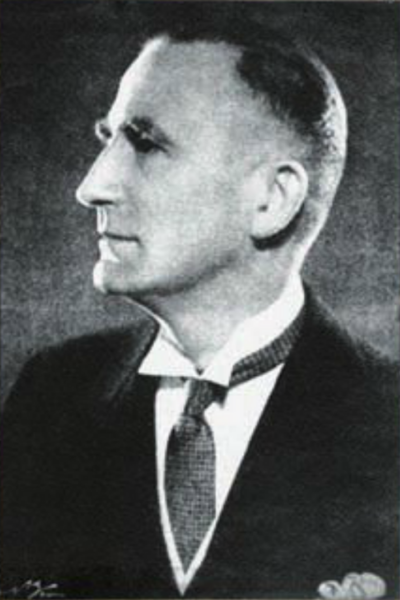
Andriy Melnyk
Andriy Melnyk was an Ukrainian military officer and politician. Born December 12, 1890, in Volia Iakubova. Died November 1, 1964, in Cologne. Awards include Military Cross.
Facts
16 facts · 2 confirmed by two sources · 3 cited · 11 from one source
Where this comes from
Papalocal keeps its own record. It started from these sources; what each one said is kept here as it was copied, so a change on their side never changes this page by itself. Tap one to read its version.
What Wikidata says · copied November 18, 2026 · revision 2569222677
- Described as
- Ukrainian military officer and politician (1890–1964)
- Other names
- Andriy Atanasovich Melnyk
- Born
- December 12, 1890
- Died
- November 1, 1964
- Born in
- Volia Iakubova
- Died in
- Cologne · 1 reference
- Buried in
- Luxembourg (–2026); National Military Memorial Cemetery (2026–)
- Citizen of
- Second Polish Republic; Ukrainian People's Republic
- Occupation
- politician · 1 reference; military officer · 1 reference
- Political party
- Organization of Ukrainian Nationalists
- Awards
- Military Cross
- Spouse
- Sofia Fedak-Melnyk
- Religion
- Ukrainian Greek Catholic Church
- Military branch
- Ukrainian People's Army
- Military rank
- colonel
- Wikipedias with a page
- 23
Wikidata item Q117559 (wikidata.org/wiki/Q117559), public domain (CC0). Copied November 18, 2026.
What Wikipedia says · copied November 18, 2026 · revision 1379843087
Andriy Atanasovych Melnyk (Ukrainian: Андрій Атанасович Мельник; 12 December 1890 – 1 November 1964) was a Ukrainian military and political leader best known for leading the Organisation of Ukrainian Nationalists from 1938 onwards and later the Melnykites (OUN-M) following a split with the more radical Banderite faction (OUN-B) in 1940.
Born in Austrian Galicia, Melnyk volunteered in the Legion of Ukrainian Sich Riflemen at the outbreak of the First World War and was later captured by the Russians in 1916. He escaped captivity in late 1917 and served as a senior officer in the army of the Ukrainian People's Republic during the Ukrainian War of Independence, rising to the rank of colonel. Melnyk went on to cofound the Ukrainian Military Organisation (UVO) in 1920 that continued the armed struggle against Poland in Western Ukraine and which later formed the Organisation of Ukrainian Nationalists (OUN) in 1929. Following his time in prison between 1924 and 1928 in connection with the Olha Basarab case, he largely stepped back from active engagement in the UVO–OUN underground.
After the assassination of Yevhen Konovalets by the NKVD, Melnyk was selected to lead the OUN and collaborated with Nazi intelligence to plan the largely aborted OUN Uprising of 1939 during the German invasion of Poland. Following the factional split, he continued to direct the OUN-M to collaborate with Nazi Germany during the German invasion of the Soviet Union on the Eastern Front. However, Melnyk had his movements confined to Berlin from mid-1941, though he would continue to advocate collaboration, and was arrested by the Gestapo in January 1944. He was initially held as a Sonderhaftling in Hirschegg from March, before being moved to Sachsenhausen concentration camp in July.
Melnyk was released in October and taken to Berlin in order to negotiate support for the retreating German Army, assuming a leading role in brokering a common stance between a broad spectrum of Ukrainian nationalist groups represented under the Ukrainian National Committee. However, with the war nearing its end and Nazi officials still rejecting demands for the recognition of an independent Ukrainian state, Melnyk and his supporters withdrew from the committee and travelled west in early 1945 to meet the Allied advance.
Melnyk continued to lead the OUN-M in exile until his death in 1964 and lobbied for the consolidation of Ukrainian diaspora organisations, with the World Congress of Free Ukrainians founded in 1967. In May 2026, the Ukrainian government organised the transfer of Melnyk and his wife Sofia's remains from Luxembourg to Ukraine, whereafter they were reburied with state honours in the National Military Memorial Cemetery, near Kyiv.
- Born, in its opening lines
- December 12, 1890
- Died, in its opening lines
- November 1, 1964
From the Wikipedia article “Andriy Melnyk (officer)” (en.wikipedia.org/wiki/Andriy_Melnyk_(officer)), by its contributors, under CC BY-SA 4.0 (creativecommons.org/licenses/by-sa/4.0/). Copied November 18, 2026; not changed.
Confirmed Two sources agree. Cited One source, and it names where it got it. One source One source, without a reference of its own. Sources disagree The sources disagree. We show the best-supported value and keep theirs below.
