
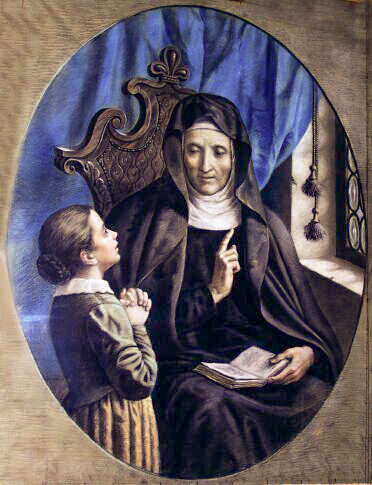
Angela Merici
Angela Merici was a Foundress of the Ursulines. Born March 21, 1474, in Desenzano del Garda. Died January 27, 1540, in Brescia.
Facts
7 facts · 2 confirmed by two sources · 2 cited · 3 from one source
Where this comes from
Papalocal keeps its own record. It started from these sources; what each one said is kept here as it was copied, so a change on their side never changes this page by itself. Tap one to read its version.
What Wikidata says · copied November 16, 2026 · revision 2565753022
- Described as
- Foundress of the Ursulines
- Other names
- Angela von Brescia, Αγγελική της Μπρέσια
- Born
- March 21, 1474 · 2 references
- Died
- January 27, 1540 · 6 references
- Born in
- Desenzano del Garda · 2 references
- Died in
- Brescia · 1 reference
- Buried in
- Sant'Angela Merici
- Occupation
- nun
- Religion
- Catholic Church
- Wikipedias with a page
- 39
Wikidata item Q236216 (wikidata.org/wiki/Q236216), public domain (CC0). Copied November 16, 2026.
What Wikipedia says · copied November 16, 2026 · revision 1384402559
Angela Merici ( mə-REE-chee, Italian: [ˈandʒela meˈriːtʃi]; 21 March 1474 – 27 January 1540) was an Italian Catholic religious educator who founded the Company of St. Ursula in 1535 in Brescia, in which women dedicated their lives to the service of the church through the education of girls.
From this organisation later sprang the Order of Saint Ursula, whose nuns established places of prayer and learning throughout Europe and, later, worldwide, most notably in North America.
After her death, Merici was venerated by Catholics around the world and a cause for sainthood was opened. She was canonized by Pope Pius VII in 1807.
- Born, in its opening lines
- March 21, 1474
- Died, in its opening lines
- January 27, 1540
From the Wikipedia article “Angela Merici” (en.wikipedia.org/wiki/Angela_Merici), by its contributors, under CC BY-SA 4.0 (creativecommons.org/licenses/by-sa/4.0/). Copied November 16, 2026; not changed.
Confirmed Two sources agree. Cited One source, and it names where it got it. One source One source, without a reference of its own. Sources disagree The sources disagree. We show the best-supported value and keep theirs below.
