
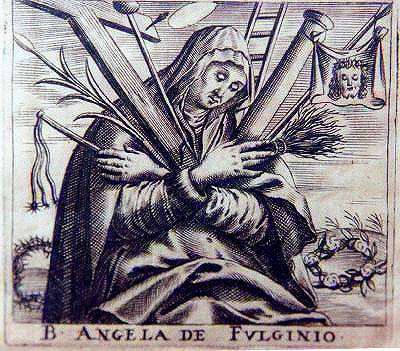
Angela of Foligno was an Italian saint. Born 1248, in Foligno. Died January 4, 1309, in Foligno.
Facts
7 facts · 2 confirmed by two sources · 2 cited · 2 from one source · 1 where the sources disagree
What’s different
- Died: we show January 4, 1309 (Confirmed). Wikidata also lists January 12, 1309
- Buried in: we show Umbria (Sources disagree). Wikidata also lists province of Perugia
Where this comes from
Papalocal keeps its own record. It started from these sources; what each one said is kept here as it was copied, so a change on their side never changes this page by itself. Tap one to read its version.
What Wikidata says · copied November 16, 2026 · revision 2564815764
- Described as
- Italian saint
- Other names
- Mistress of Theologians, Blessed Angela of Foligno
- Born
- 1248 · 15 references
- Died
- January 4, 1309 · 2 references; January 12, 1309 · 1 reference
- Born in
- Foligno · 1 reference
- Died in
- Foligno · 1 reference
- Buried in
- Umbria; province of Perugia
- Occupation
- nun
- Religion
- Catholic Church
- Wikipedias with a page
- 31
Wikidata item Q240297 (wikidata.org/wiki/Q240297), public domain (CC0). Copied November 16, 2026.
What Wikipedia says · copied November 16, 2026 · revision 1352189609
Angela of Foligno (1248 – 4 January 1309) was an Italian Franciscan tertiary who became known as a mystic from her extensive writings about her mystical revelations. Due to the respect those writings engendered in the Catholic Church she became known as Theologorum Magistra ("Teacher of Theologians"), as first used by Maximilian Sandaeus, later cited by Bollandus in the Acta Sanctorum.
Angela was noted not only for her spiritual writings, but also for founding a religious community which refused to become an enclosed order so that it might continue her vision of caring for those in need.
The Catholic Church declared Angela to be a saint in 2013. Her canonization was an “equivalent canonization” (without executing the ordinary judicial process of canonization).
- Born, in its opening lines
- 1248
- Died, in its opening lines
- January 4, 1309
From the Wikipedia article “Angela of Foligno” (en.wikipedia.org/wiki/Angela_of_Foligno), by its contributors, under CC BY-SA 4.0 (creativecommons.org/licenses/by-sa/4.0/). Copied November 16, 2026; not changed.
Confirmed Two sources agree. Cited One source, and it names where it got it. One source One source, without a reference of its own. Sources disagree The sources disagree. We show the best-supported value and keep theirs below.
