
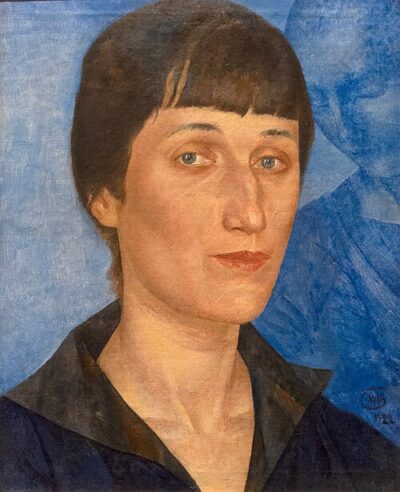
Anna Akhmatova
Anna Akhmatova was a Russian poet. Born June 11, 1889, in Odesa. Died March 5, 1966, in Domodedovo. Educated at Tsarskoye Selo Girls School and Fundukleev Women's Gymnasium. Awards include Taormina prize, Medal "For the Defence of Leningrad" and Jubilee Medal Medal "In Commemoration of the 250th Anniversary of Leningrad".
Facts
34 facts · 1 confirmed by two sources · 14 cited · 18 from one source · 1 where the sources disagree
What’s different
- Born: we show June 11, 1889 (Sources disagree). Wikipedia says June 23, 1889
Where this comes from
Papalocal keeps its own record. It started from these sources; what each one said is kept here as it was copied, so a change on their side never changes this page by itself. Tap one to read its version.
What Wikidata says · copied November 16, 2026 · revision 2570044382
- Described as
- Russian poet (1889–1966)
- Other names
- Anna Achmatova, Anna Ahmatova, Anna Andreevna Gorenko, Anna Andreevna Akhmatova, А́нна Андре́евна Ахма́това, Anna A. Ahmatova, Anna Gorenko, Anna Andreyevna Gorenko
- Born
- June 11, 1889 · 3 references
- Died
- March 5, 1966 · 15 references
- Born in
- Odesa · 5 references
- Died in
- Domodedovo · 5 references
- Buried in
- Cemetery in Komarovo
- Cause of death
- infarction
- Name at birth
- Анна Андреевна Горенко
- Citizen of
- Russian Empire · 2 references; Soviet Union · 2 references
- Occupation
- writer · 4 references; translator; literary critic; poet · 2 references; literary scholar · 1 reference; librettist · 1 reference
- Education
- Tsarskoye Selo Girls School; Fundukleev Women's Gymnasium; Women's Higher Courses (Kyiv)
- Awards
- Taormina prize (1964) · 1 reference; Medal "For the Defence of Leningrad"; Jubilee Medal Medal "In Commemoration of the 250th Anniversary of Leningrad" (1957) · 1 reference; Medal "For Valiant Labour in the Great Patriotic War 1941–1945" (1946) · 1 reference
- Field
- poetry
- Spouse
- Nikolay Gumilev (1910–1918) · 4 references; Vladimir Shileyko (1918–1926) · 1 reference; Nikolay Punin (1922–1935) · 1 reference
- Children
- Lev Gumilev · 1 reference
- Father
- Andrey Gorenko · 1 reference
- Mother
- Inna Stogova
- Religion
- Eastern Orthodoxy
- Lived in
- Odesa; Saint Petersburg; Tashkent; Kyiv
- Wikipedias with a page
- 132
Wikidata item Q80440 (wikidata.org/wiki/Q80440), public domain (CC0). Copied November 16, 2026.
What Wikipedia says · copied November 16, 2026 · revision 1383896443
Anna Andreyevna Gorenko (23 June [O.S. 11 June] 1889 – 5 March 1966), known by her pen name Anna Akhmatova, was a Russian and Soviet poet. She was nominated for the Nobel Prize in Literature in 1965 and 1966.
Akhmatova's work ranges from short lyric poems to intricately structured cycles, such as Requiem (1935–40), her tragic masterpiece about the Stalinist terror. Her style, characterised by its economy and emotional restraint, was strikingly original and distinctive to her contemporaries. The strong and clear leading female voice struck a new chord in Russian poetry. Her writing can be said to fall into two periods – the early work (1912–25) and her later work (from around 1936 until her death), divided by a decade of reduced literary output. Her work was condemned and censored by Stalinist authorities, and she is notable for choosing not to emigrate and remaining in the Soviet Union, acting as witness to the events around her. Her perennial themes include meditations on time and memory, and the difficulties of living and writing in the shadow of Stalinism.
Primary sources of information about Akhmatova's life are relatively scant, as war, revolution and the Soviet regime caused much of the written record to be destroyed. For long periods she was in official disfavour and many of those who were close to her died in the aftermath of the revolution. Akhmatova's first husband, Nikolai Gumilev, was executed by the Cheka, and her son Lev Gumilev and her common-law husband Nikolay Punin spent many years in the Gulag, where Punin died.
- Born, in its opening lines
- June 23, 1889
- Died, in its opening lines
- March 5, 1966
From the Wikipedia article “Anna Akhmatova” (en.wikipedia.org/wiki/Anna_Akhmatova), by its contributors, under CC BY-SA 4.0 (creativecommons.org/licenses/by-sa/4.0/). Copied November 16, 2026; not changed.
Confirmed Two sources agree. Cited One source, and it names where it got it. One source One source, without a reference of its own. Sources disagree The sources disagree. We show the best-supported value and keep theirs below.
