
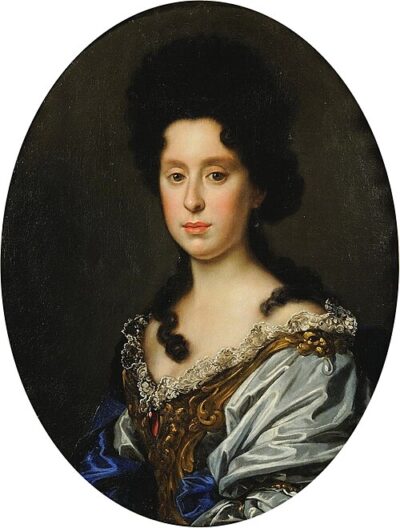
Anna Maria Luisa de' Medici
Anna Maria Luisa de' Medici was a Wife of Johann Wilhelm Palatine Elector. Born August 11, 1667, in Florence. Died February 18, 1743, in Florence. Positions held include Electress (1691–1716). Awards include Order of the Starry Cross.
Facts
16 facts · 2 confirmed by two sources · 5 cited · 9 from one source
Where this comes from
Papalocal keeps its own record. It started from these sources; what each one said is kept here as it was copied, so a change on their side never changes this page by itself. Tap one to read its version.
What Wikidata says · copied November 16, 2026 · revision 2570010178
- Described as
- Wife of Johann Wilhelm Palatine Elector (1667-1743)
- Born
- August 11, 1667 · 5 references
- Died
- February 18, 1743 · 5 references
- Born in
- Florence · 1 reference
- Died in
- Florence · 1 reference
- Buried in
- Basilica of San Lorenzo
- Citizen of
- Grand Duchy of Tuscany
- Occupation
- art collector · 1 reference
- Positions held
- Electress (1691–1716)
- Awards
- Order of the Starry Cross
- Spouse
- Johann Wilhelm, Elector Palatine (1691–1716) · 1 reference
- Father
- Cosimo III de' Medici, Grand Duke of Tuscany · 1 reference
- Mother
- Marguerite Louise d'Orléans
- Siblings
- Ferdinando de' Medici, Grand Prince of Tuscany; Gian Gastone de' Medici · 1 reference
- Religion
- Catholicism
- Lived in
- Palazzo Pitti
- Wikipedias with a page
- 30
Wikidata item Q233181 (wikidata.org/wiki/Q233181), public domain (CC0). Copied November 16, 2026.
What Wikipedia says · copied November 16, 2026 · revision 1358297779
Anna Maria Luisa de' Medici (11 August 1667 – 18 February 1743) was an Italian noblewoman who was the last lineal descendant of the main branch of the House of Medici. A patron of the arts, she bequeathed the Medicis' large art collection, including the contents of the Uffizi, Palazzo Pitti, and the Medici villas, which she inherited upon her brother Gian Gastone's death in 1737, and her Palatine treasures to the Tuscan state, on the condition that no part of it could be removed from "the Capital of the grand ducal State....[and from] the succession of His Serene Grand Duke."
Anna Maria Luisa was the only daughter of Cosimo III de' Medici, Grand Duke of Tuscany, and Marguerite Louise d'Orléans, a niece of Louis XIII of France. On her marriage to Johann Wilhelm, Elector Palatine, she became Electress of the Palatinate, and, by patronising musicians, she earned for the contemporary Palatine court the reputation of an important music centre. After a single miscarriage, her marriage remained childless, which, combined with her siblings' barrenness, meant that the Medici were on the verge of extinction.
In 1713 Cosimo III altered the Tuscan laws of succession to allow the accession of his daughter, and spent his final years canvassing the European powers to agree to recognise this statute. However, in 1735, as part of a territorial arrangement, the European powers appointed Duke Francis Stephen of Lorraine as heir, and he duly ascended the Tuscan throne in her stead. After the death of Johann Wilhelm, Anna Maria Luisa returned to Florence, where she enjoyed the rank of first lady until the accession of her brother Gian Gastone, who banished her to the Villa La Quiete. When Gian Gastone died in 1737, Francis Stephen's envoy offered Anna Maria Luisa the position of nominal regent of Tuscany, but she declined. Her death, in 1743, brought the grand ducal House of Medici to an end. Her remains were interred in the Medicean necropolis, Basilica of San Lorenzo, Florence, which she helped complete.
- Born, in its opening lines
- August 11, 1667
- Died, in its opening lines
- February 18, 1743
From the Wikipedia article “Anna Maria Luisa de' Medici” (en.wikipedia.org/wiki/Anna_Maria_Luisa_de'_Medici), by its contributors, under CC BY-SA 4.0 (creativecommons.org/licenses/by-sa/4.0/). Copied November 16, 2026; not changed.
Confirmed Two sources agree. Cited One source, and it names where it got it. One source One source, without a reference of its own. Sources disagree The sources disagree. We show the best-supported value and keep theirs below.
