
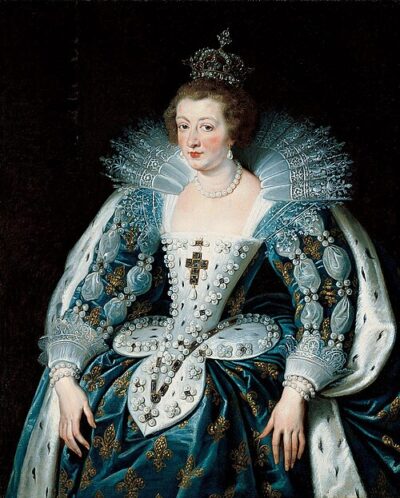
Anne of Austria
Anne of Austria was a Queen, consort of Louis XIII, King of France, lived. Born September 22, 1601, in Valladolid. Died January 20, 1666, in Paris. Positions held include governor of Brittany.
Facts
25 facts · 2 confirmed by two sources · 6 cited · 17 from one source
Where this comes from
Papalocal keeps its own record. It started from these sources; what each one said is kept here as it was copied, so a change on their side never changes this page by itself. Tap one to read its version.
What Wikidata says · copied November 16, 2026 · revision 2557770830
- Described as
- Queen, consort of Louis XIII, King of France, lived (1601-1666)
- Other names
- Queen Anne, Ana de Austria, Anne d’Autriche, Queen consort of Louis XIII Anne, Ana María Mauricia, Anne d'Autriche, Anne, Queen, consort of Louis XIII, King of France Anne, Ana Maria Mauricia, Anna van Habsburg (1601-1666), Anna of Austria (1601-1666), Anne Maurice of Austria
- Born
- September 22, 1601 · 13 references
- Died
- January 20, 1666 · 13 references
- Born in
- Valladolid
- Died in
- Paris
- Buried in
- Basilica of Saint-Denis
- Cause of death
- breast cancer
- Name at birth
- Ana María Mauricia de Austria y Austria-Estiria
- Citizen of
- Spain; France; Kingdom of Portugal
- Occupation
- queen regnant
- Positions held
- governor of Brittany
- Spouse
- Louis XIII of France (1615–1643) · 3 references
- Children
- Louis XIV of France · 1 reference; Philippe I, Duke of Orléans · 1 reference
- Father
- Philip III of Spain · 1 reference
- Mother
- Margaret of Austria, Queen of Spain · 1 reference
- Siblings
- Maria Anna of Spain; Cardinal-Infante Ferdinand of Austria; Philip IV of Spain · 1 reference; Infante Carlos of Spain; Infante Alonso of Austria · 1 reference; Infanta Margarita of Spain; Infanta Maria of Austria
- Religion
- Catholic Church
- Wikipedias with a page
- 59
Wikidata item Q151209 (wikidata.org/wiki/Q151209), public domain (CC0). Copied November 16, 2026.
What Wikipedia says · copied November 16, 2026 · revision 1384512145
Anne of Austria (French: Anne d'Autriche; Spanish: Ana de Austria; born Ana María Mauricia; 22 September 1601 – 20 January 1666) was Queen of France from 1615 to 1643 by marriage to King Louis XIII. She was also Queen of Navarre until the kingdom's annexation into the French crown in 1620. After her husband's death, Anne was regent to her son Louis XIV during his minority until 1651.
Anne was born in Valladolid to King Philip III of Spain and Margaret of Austria. She was betrothed to King Louis XIII of France in 1612 and they married three years later. The two had a difficult marital relationship, exacerbated by her miscarriages and the anti-Habsburg stance of Louis' first minister, Cardinal Richelieu. Despite a climate of distrust amidst the Franco-Spanish War and twenty-three years of childlessness in which she suffered five miscarriages, Anne gave birth to an heir, Louis, in 1638 and a second son, Philippe, two years later.
When Louis XIII died in 1643, Anne outmaneuvered her opponents to become sole regent to her four-year-old son, Louis XIV, and appointed Cardinal Mazarin as chief minister. The Fronde, a major revolt by the French nobility against Anne and Mazarin's government, broke out but was ultimately suppressed. In 1651, Anne's regency formally ended when Louis was declared of age. Accounts of French court life of her era emphasize her closeness to her son, and her disapproval of his infidelity to her niece and daughter-in-law Maria Theresa. She retired from active politics in 1661 and moved to the convent she had commissioned, Val-de-Grâce, where she died of breast cancer five years later.
- Born, in its opening lines
- September 22, 1601
- Died, in its opening lines
- January 20, 1666
From the Wikipedia article “Anne of Austria” (en.wikipedia.org/wiki/Anne_of_Austria), by its contributors, under CC BY-SA 4.0 (creativecommons.org/licenses/by-sa/4.0/). Copied November 16, 2026; not changed.
Confirmed Two sources agree. Cited One source, and it names where it got it. One source One source, without a reference of its own. Sources disagree The sources disagree. We show the best-supported value and keep theirs below.
