
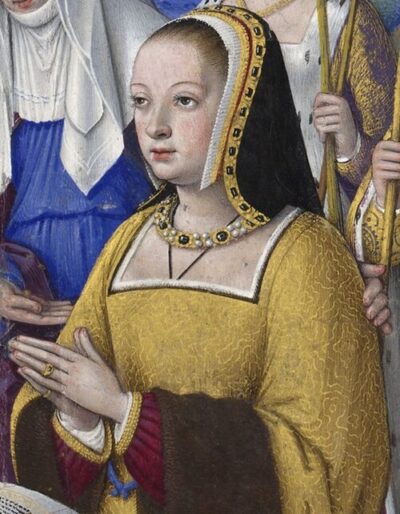
Anne of Brittany
Anne of Brittany was a Duchess of Brittany and twice Queen of France. Born January 25, 1477, in Château des ducs de Bretagne. Died January 9, 1514, in Blois.
Facts
20 facts · 1 confirmed by two sources · 8 cited · 10 from one source · 1 where the sources disagree
What’s different
- Born: we show January 25, 1477 (Sources disagree). Wikipedia says January 26, 1477
Where this comes from
Papalocal keeps its own record. It started from these sources; what each one said is kept here as it was copied, so a change on their side never changes this page by itself. Tap one to read its version.
What Wikidata says · copied November 16, 2026 · revision 2557770762
- Described as
- Duchess of Brittany and twice Queen of France (1477-1514)
- Other names
- Anne de Bretagne
- Born
- January 25, 1477 · 1 reference
- Died
- January 9, 1514 · 1 reference
- Born in
- Château des ducs de Bretagne
- Died in
- Blois · 1 reference
- Buried in
- Basilica of Saint-Denis
- Citizen of
- France · 1 reference
- Occupation
- royalty
- Spouse
- Charles VIII of France (1491–1498) · 2 references; Louis XII of France (1499–1514) · 2 references; Maximilian I (1490–1491) · 1 reference
- Children
- Charles Orlando, Dauphin of France; Claude of France · 1 reference; Renee of France; Charles de France; François de France; Anne de France
- Father
- Francis II · 1 reference
- Mother
- Margaret of Foix · 1 reference
- Siblings
- Isabeau of Brittany
- Religion
- Catholic Church
- Wikipedias with a page
- 60
Wikidata item Q201143 (wikidata.org/wiki/Q201143), public domain (CC0). Copied November 16, 2026.
What Wikipedia says · copied November 16, 2026 · revision 1381913241
Anne of Brittany (Breton: Anna; 25/26 January 1477 – 9 January 1514) was suo jure Duchess of Brittany from 1488 until her death, and Queen of France from 1491 to 1498 and again from 1499 to her death. She was the only woman to have been queen consort of France twice.
Anne was raised in Nantes during a series of conflicts in which the King of France sought to assert his suzerainty over Brittany. Her father, Francis II, Duke of Brittany, was the last male heir of the House of Montfort. Upon his death in 1488, Anne became duchess of Brittany, countess of Nantes, Montfort, and Richmond, and viscountess of Limoges. She was only 11 at that time, but she was already considered a desirable prospect for marriage because of Brittany's strategic position. The next year, she married Maximilian I of Austria by proxy, but Charles VIII of France saw this as a threat since his realm was located between Brittany and Austria. He started a military campaign which eventually forced the duchess to renounce her marriage.
Anne eventually married Charles VIII in 1491. None of their children survived early childhood, and when the king died in 1498, the throne went to his cousin, Louis XII. Following an agreement made to secure the annexation of Brittany, Anne had to marry the new king. Louis XII was deeply in love with his wife and Anne had many opportunities to reassert the independence of her duchy. They had two daughters — although neither could succeed to the French throne due to the Salic law, the elder was proclaimed the heiress of Brittany. Anne managed to have her elder daughter engaged to Charles of Austria, grandchild of Maximilian I, but after Anne's death in 1514, her daughter married her cousin Francis I of France. This marriage later led to the formal union between France and Brittany.
Anne was highly regarded in Brittany as a conscientious ruler who defended the duchy against France. In the Romantic period, she became a figure of Breton patriotism and she was honoured with many memorials and statues. Her artistic legacy is important in the Loire Valley, where she spent most of her life. She was notably responsible, with her husbands, for architectural projects in the châteaux of Blois and Amboise.
- Born, in its opening lines
- January 26, 1477
- Died, in its opening lines
- January 9, 1514
From the Wikipedia article “Anne of Brittany” (en.wikipedia.org/wiki/Anne_of_Brittany), by its contributors, under CC BY-SA 4.0 (creativecommons.org/licenses/by-sa/4.0/). Copied November 16, 2026; not changed.
Confirmed Two sources agree. Cited One source, and it names where it got it. One source One source, without a reference of its own. Sources disagree The sources disagree. We show the best-supported value and keep theirs below.
