
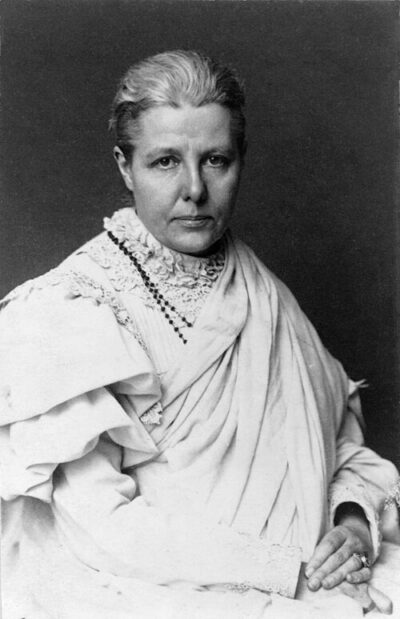
Annie Besant
Annie Besant was a British socialist, theosophist, women's rights activist, writer and orator. Born October 1, 1847, in Clapham. Died September 20, 1933, in Adyar. Known for The Ancient Wisdom and Thought-Forms: A Record of Clairvoyant Investigation. Educated at Birkbeck, University of London. Awards include Subba Row Medal and Silver Wolf Award.
Facts
30 facts · 2 confirmed by two sources · 19 cited · 9 from one source
Where this comes from
Papalocal keeps its own record. It started from these sources; what each one said is kept here as it was copied, so a change on their side never changes this page by itself. Tap one to read its version.
What Wikidata says · copied November 16, 2026 · revision 2564498651
- Described as
- British socialist, theosophist, women's rights activist, writer and orator (1847-1933)
- Other names
- Mrs. Annie Besant, née Wood, Annie Wood, Annie Wood Besant
- Born
- October 1, 1847 · 12 references
- Died
- September 20, 1933 · 11 references
- Born in
- Clapham · 1 reference
- Died in
- Adyar · 1 reference
- Name at birth
- Annie Wood · 1 reference
- Citizen of
- United Kingdom of Great Britain and Ireland (–1927); United Kingdom · 1 reference
- Occupation
- essayist; writer · 2 references; orator · 1 reference; journalist · 2 references; editor · 2 references; politician · 2 references; feminist · 1 reference; theosophist · 2 references
- Political party
- Indian National Congress · 1 reference
- Education
- Birkbeck, University of London
- Member of
- Fabian Society · 1 reference; National Secular Society · 1 reference; Theosophical Society Adyar
- Known for
- The Ancient Wisdom · 1 reference; Thought-Forms: A Record of Clairvoyant Investigation · 1 reference
- Awards
- Subba Row Medal (1895) · 1 reference; Silver Wolf Award (1933) · 1 reference
- Field
- essay
- Children
- Mabel Besant-Scott · 1 reference; Jiddu Krishnamurti
- Siblings
- Henry Trueman Wright Wood
- Religion
- Hinduism; Theosophy
- Wikipedias with a page
- 82
Wikidata item Q464318 (wikidata.org/wiki/Q464318), public domain (CC0). Copied November 16, 2026.
What Wikipedia says · copied November 16, 2026 · revision 1383501367
Annie Besant (; née Wood; 1 October 1847 – 20 September 1933) was an English socialist, theosophist, freemason, educationist, and activist involved in women's rights, Home Rule, and Indian nationalism. She supported Irish and Indian self-rule. She became the first female president of the Indian National Congress in 1917.
She became a prominent speaker for the National Secular Society (NSS), a writer, and a close friend of Charles Bradlaugh. In 1877 they were prosecuted for publishing a book by birth control campaigner Charles Knowlton. Thereafter, she became involved with union actions, including the Bloody Sunday demonstration and the London matchgirls strike of 1888. She was a leading speaker for both the Fabian Society and the Marxist Social Democratic Federation (SDF). She was also elected to the London School Board for Tower Hamlets, topping the poll, even though few women were qualified to vote then.
In 1890 Besant met Helena Blavatsky, and over the next few years her interest in theosophy grew, whilst her interest in secular matters waned. She became a member of the Theosophical Society and a prominent lecturer on the subject. As part of her theosophy-related work, she travelled to India. In 1898 she helped establish the Central Hindu School, and in 1922 she helped establish the Hyderabad (Sind) National Collegiate Board in Bombay (today's Mumbai), India. The Theosophical Society Auditorium in Hyderabad, Sindh (Sindh) is called Besant Hall in her honour. In 1902, she established the first overseas Lodge of the International Order of Co-Freemasonry, Le Droit Humain. Over the next few years, she established lodges in many parts of the British Empire. In 1907 she became president of the Theosophical Society, whose international headquarters were, by then, located in Adyar, Madras (Chennai).
Besant also became active in politics in India, joining the Indian National Congress. When World War I broke out in 1914, she helped launch the Home Rule League to campaign for democracy in India, and dominion status within the British Empire. This led to her election as president of the Indian National Congress in late 1917. In the late 1920s, Besant travelled to the United States with her protégé and adopted son Jiddu Krishnamurti, whom she claimed was the new Messiah and incarnation of Buddha. Krishnamurti rejected these claims in 1929. After the war, she continued to campaign for Indian independence and for the causes of theosophy. She died in 1933.
- Born, in its opening lines
- October 1, 1847
- Died, in its opening lines
- September 20, 1933
From the Wikipedia article “Annie Besant” (en.wikipedia.org/wiki/Annie_Besant), by its contributors, under CC BY-SA 4.0 (creativecommons.org/licenses/by-sa/4.0/). Copied November 16, 2026; not changed.
Confirmed Two sources agree. Cited One source, and it names where it got it. One source One source, without a reference of its own. Sources disagree The sources disagree. We show the best-supported value and keep theirs below.
