
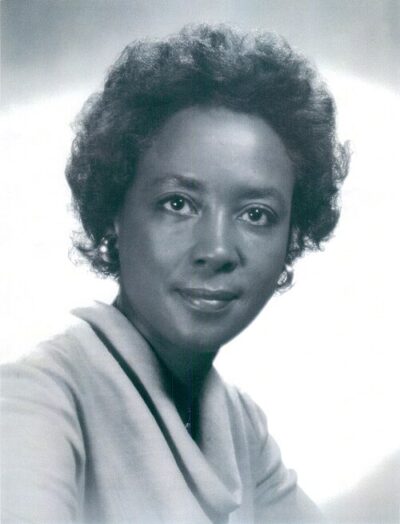
Annie Easley
Annie Easley was an American mathematician and rocket scientist. Born April 23, 1932, in Birmingham. Died June 25, 2011, in Cleveland. Educated at Cleveland State University and Xavier University of Louisiana.
Facts
13 facts · 1 confirmed by two sources · 4 cited · 7 from one source · 1 where the sources disagree
What’s different
- Born: we show April 23, 1932 (Sources disagree). Wikipedia says April 23, 1933
Where this comes from
Papalocal keeps its own record. It started from these sources; what each one said is kept here as it was copied, so a change on their side never changes this page by itself. Tap one to read its version.
What Wikidata says · copied November 15, 2026 · revision 2569092782
- Described as
- American mathematician and rocket scientist
- Other names
- Annie J. Easley, Annie Jean Easley
- Born
- April 23, 1932 · 1 reference
- Died
- June 25, 2011 · 2 references
- Born in
- Birmingham · 2 references
- Died in
- Cleveland
- Citizen of
- United States · 1 reference
- Occupation
- mathematician · 1 reference; computer scientist · 1 reference; engineer · 1 reference
- Worked for
- National Aeronautics and Space Administration; NASA (1955–) · 1 reference
- Education
- Cleveland State University · 1 reference; Xavier University of Louisiana · 1 reference
- Field
- computer engineering · 1 reference
- Wikipedias with a page
- 33
Wikidata item Q11586 (wikidata.org/wiki/Q11586), public domain (CC0). Copied November 15, 2026.
What Wikipedia says · copied November 15, 2026 · revision 1385605747
Annie Jean Easley (April 23, 1933 – June 25, 2011) was an American computer scientist who contributed significantly to the beginning iterations of NASA's rocket technologies.
Easley was born in 1933 in Birmingham, Alabama, and was raised by a single mother. Segregation disallowed Annie from many normal job opportunities that others of different color and gender might get, but her mother strived for her to have a good education nonetheless. She attended Holy Family High School for most of her schooling life, culminating in her graduating as valedictorian.
From there, Easley enrolled at Xavier University in New Orleans to study pharmacy. Her interest in the subject waned from her initial excitement, and she returned to Birmingham briefly in 1945 to vote but was subjected to the poll tax. Her college experiences helped her to encourage other women to overcome some of the voting restrictions.
Eventually, Easley would get married and move to Cleveland, Ohio with the intention of attending the School of Pharmacy. However, she could not as the local university had shut down their School of Pharmacy. She read an article in the paper about a mathematician opportunity in NASA. Following that reading, her career started as a NASA engineer and spanned decades, inspiring many women of color and outreach programs to support women in STEM fields.
Her innovation in programming technologies, energy-conversion, and shuttle launches made her a significant part of NASA’s history and addressed a major pain point they had at the time: lack of interdisciplinary mathematicians and programmers. The work she did spanned all aspects of her life, from her previous degrees to her newly learned languages and work of battery cells all contributed greatly to NASA’s project Centaur launches and paved the way forward for future iterations of space shuttles. Additionally, her work in outreach programs for young innovators and mathematicians was instrumental in breaking down gender barriers for STEM.
- Born, in its opening lines
- April 23, 1933
- Died, in its opening lines
- June 25, 2011
From the Wikipedia article “Annie Easley” (en.wikipedia.org/wiki/Annie_Easley), by its contributors, under CC BY-SA 4.0 (creativecommons.org/licenses/by-sa/4.0/). Copied November 15, 2026; not changed.
Confirmed Two sources agree. Cited One source, and it names where it got it. One source One source, without a reference of its own. Sources disagree The sources disagree. We show the best-supported value and keep theirs below.
