
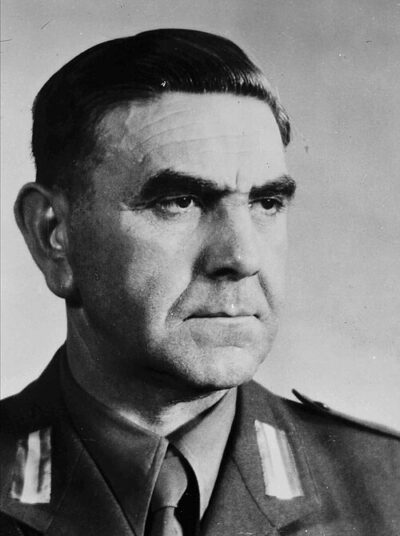
Ante Pavelić
Ante Pavelić was a Croatian fascist general and military dictator. Born July 14, 1889, in Bradina. Died December 28, 1959, in Madrid. Positions held include Poglavnik (1941–1945). Educated at Faculty of Law of the University of Zagreb and University of Zagreb. Awards include Military Order of the Iron Trefoil, Grand Cross of the Order of the White Rose of Finland and Order of the German Eagle.
Facts
37 facts · 2 confirmed by two sources · 2 cited · 32 from one source · 1 where the sources disagree
What’s different
- Buried in: we show San Isidro Cemetery (Sources disagree). Wikidata also lists Madrid
Where this comes from
Papalocal keeps its own record. It started from these sources; what each one said is kept here as it was copied, so a change on their side never changes this page by itself. Tap one to read its version.
What Wikidata says · copied November 16, 2026 · revision 2569128441
- Described as
- Croatian fascist general and military dictator (1889–1959)
- Born
- July 14, 1889 · 5 references
- Died
- December 28, 1959 · 8 references
- Born in
- Bradina
- Died in
- Madrid · 2 references
- Buried in
- San Isidro Cemetery · 1 reference; Madrid · 1 reference
- Cause of death
- gunshot wound
- Citizen of
- Austro-Hungarian rule in Bosnia and Herzegovina; Kingdom of Serbs, Croats and Slovenes; Kingdom of Yugoslavia; Independent State of Croatia
- Occupation
- politician · 1 reference; lawyer; military personnel · 1 reference; Holocaust perpetrator · 1 reference
- Positions held
- Poglavnik (1941–1945)
- Political party
- Ustaše (1929–); Croatian Pure Party of Rights; Croatian Party of Rights · 1 reference; Croatian Liberation Movement · 1 reference
- Education
- Faculty of Law of the University of Zagreb; University of Zagreb · 1 reference
- Awards
- Military Order of the Iron Trefoil; Grand Cross of the Order of the White Rose of Finland (1943) · 1 reference; Order of the German Eagle; Knight Grand Cross of the Order of Saints Maurice and Lazarus (1941); Rad Slovenskeho kriza 1940-1944; Order of the Crown of King Zvonimir · 1 reference; Order of the White Rose of Finland · 1 reference; Order of Saints Maurice and Lazarus · 1 reference; Hungarian Order of Merit · 1 reference; Imperial Order of the Yoke and Arrows · 1 reference
- Field
- advocate · 1 reference; politician · 1 reference; revolutionary · 1 reference; ideology · 1 reference
- Religion
- Catholicism
- Military rank
- general
- Wikipedias with a page
- 58
Wikidata item Q36965 (wikidata.org/wiki/Q36965), public domain (CC0). Copied November 16, 2026.
What Wikipedia says · copied November 16, 2026 · revision 1385240250
Ante Pavelić (Croatian: [ǎːnte pǎʋelit͡ɕ] ; 14 July 1889 – 28 December 1959) was a Croatian politician who founded and headed the Ustaše in 1929 and was dictator of the Independent State of Croatia (NDH), a fascist puppet state built out of parts of occupied Yugoslavia by the authorities of Nazi Germany and Fascist Italy, from 1941 to 1945. Pavelić and the Ustaše persecuted many racial minorities and political opponents in the NDH during the war, including Serbs, Jews, Romani, and Yugoslav Partisans, becoming one of the key figures of the genocide of Serbs, the Porajmos and the Holocaust in the NDH.
At the start of his career, Pavelić was a lawyer and a politician of the Croatian Party of Rights in the Kingdom of Yugoslavia known for his nationalist beliefs and support for an independent Croatia. By the end of the 1920s, his political activity became more radical as he called on Croats to revolt against Yugoslavia, and schemed an Italian protectorate of Croatia separate from Yugoslavia. After King Alexander I declared his 6 January Dictatorship in 1929 and banned all political parties, Pavelić went abroad and plotted with the Internal Macedonian Revolutionary Organization (IMRO) to undermine the Yugoslav state, which prompted the Yugoslav authorities to try him in absentia and sentence him to death. In the meantime, Pavelić had moved to Fascist Italy where he founded the Ustaše, a Croatian nationalist movement with the goal of creating an independent Croatia by any means, including the use of terror. Pavelić incorporated terrorist actions in the Ustaše program, such as train bombings and assassinations, staged a small uprising in Lika in 1932, culminating in the assassination of King Alexander in 1934 in conjunction with the IMRO. Pavelić was once again sentenced to death after being tried in France in absentia and, under international pressure, the Italians imprisoned him for 18 months, and largely obstructed the Ustaše in the following period.
At the behest of the Germans, senior Ustaša Slavko Kvaternik declared the NDH's establishment on 10 April 1941 in the name of Pavelić. Calling himself the Poglavnik, or supreme leader, Pavelić returned from Italy and took control of the puppet government. He created a political system similar to that of Fascist Italy and Nazi Germany. The NDH, though constituting a Greater Croatia, was forced by the Italians to relinquish several territorial concessions to the latter. After taking control, Pavelić imposed largely anti-Serbian, anti-Semitic and anti-Roma policies that resulted in the deaths of hundreds of thousands of Serbs, and tens of thousands of Jews and Roma in the NDH, many of which in dedicated concentration and extermination camps run by the Ustaše. Under the NDH regime, hundreds of thousands of Orthodox Christians were also forcibly converted to Catholicism, or expelled to German-occupied Serbia. These mass killings and persecutions have been described as the "single most disastrous episode in Yugoslav history".
In 1945, Pavelić ordered the executions of prominent NDH politicians Mladen Lorković and Ante Vokić on charges of treason when they were arrested for plotting to oust him and align the NDH with the Allies. Following the surrender of Germany that May, Pavelić ordered his troops to keep fighting even after the surrender. He subsequently ordered the NDH to flee to Austria to offer the surrender of their armed forces to the advancing British Army, which refused to accept it, and directed them to surrender to the Yugoslav Partisans instead. Sparked by attacks on their position, the Partisans began carrying out mass killings of surrendered Axis forces and their alleged collaborators, in which tens of thousands perished.
Pavelić fled to Austria before obtaining a false passport from the Vatican and escaping to Argentina, where he continued to engage in fascist activities. He later served as a security advisor to Juan Perón, the President of Argentina, who provided sanctuary for many fascist war criminals. On 10 April 1957, Pavelić was shot in an assassination attempt in Buenos Aires. The shooting and subsequent hospitalization caused him unwelcome public attention; fearing arrest and extradition to Yugoslavia, he fled to Francoist Spain, where he would be granted political asylum. He spent two and a half years in Spain before dying in Madrid from complications of the gunshot wounds on 28 December 1959, aged 70.
- Born, in its opening lines
- July 14, 1889
- Died, in its opening lines
- December 28, 1959
From the Wikipedia article “Ante Pavelić” (en.wikipedia.org/wiki/Ante_Pavelić), by its contributors, under CC BY-SA 4.0 (creativecommons.org/licenses/by-sa/4.0/). Copied November 16, 2026; not changed.
Confirmed Two sources agree. Cited One source, and it names where it got it. One source One source, without a reference of its own. Sources disagree The sources disagree. We show the best-supported value and keep theirs below.
