
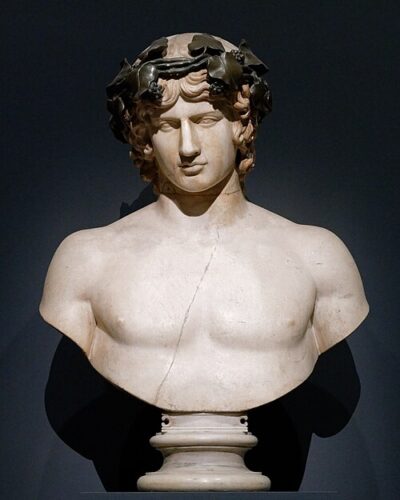
Antinous
Antinous was a lover of Roman emperor Hadrian. Born 111, in Bolu. Died October 130, in Antinoöpolis.
Facts
8 facts · 0 confirmed by two sources · 1 cited · 6 from one source · 1 where the sources disagree
What’s different
- Died in: we show Antinoöpolis (Sources disagree). Wikidata also lists Nile
Where this comes from
Papalocal keeps its own record. It started from these sources; what each one said is kept here as it was copied, so a change on their side never changes this page by itself. Tap one to read its version.
What Wikidata says · copied November 16, 2026 · revision 2567490201
- Described as
- lover of Roman emperor Hadrian
- Other names
- Antinoös, Antinoos, Ἀντίνοος, Antinoüs
- Born
- 111
- Died
- October 130
- Born in
- Bolu · 1 reference
- Died in
- Nile; Antinoöpolis · 1 reference
- Buried in
- Hadrian's Villa · 1 reference
- Cause of death
- drowning
- Citizen of
- Ancient Rome
- Occupation
- favourite
- Wikipedias with a page
- 47
Wikidata item Q171876 (wikidata.org/wiki/Q171876), public domain (CC0). Copied November 16, 2026.
What Wikipedia says · copied November 16, 2026 · revision 1385660108
Antinous, also called Antinoös, (; Ancient Greek: Ἀντίνοος; c. 111 – c. 130) was a Greek youth from Bithynia, a favourite and lover of the Roman emperor Hadrian. Following his premature death before his 20th birthday, Antinous was deified on Hadrian's orders, being worshipped in both the Greek East and Latin West, sometimes as a god (θεός, theós) and sometimes merely as a hero (ἥρως, hḗrōs).
Little is known of Antinous's life, although it is known that he was born in Claudiopolis (present day Bolu, Turkey), in the Roman province of Bithynia et Pontus. He was probably introduced to Hadrian in 123, before being taken to Italy for a higher education. He had become the favourite of Hadrian by 128, when he was taken on a tour of the Roman Empire as part of Hadrian's personal retinue. Antinous accompanied Hadrian during his attendance of the annual Eleusinian Mysteries in Athens, and was with him when he killed the Marousian lion in Libya, an event highly publicised by the Emperor. In October 130, as they were part of a flotilla going along the Nile, Antinous died amid mysterious circumstances. Various suggestions have been put forward for how he died, ranging from an accidental drowning to an intentional human sacrifice or suicide.
Following his death, Hadrian deified Antinous and founded an organised cult devoted to his worship that spread throughout the Empire. Hadrian founded the city of Antinoöpolis close to Antinous's place of death, which became a cultic centre for the worship of Osiris-Antinous. Hadrian also founded games in commemoration of Antinous to take place in both Antinoöpolis and Athens, with Antinous becoming a symbol of Hadrian's dreams of pan-Hellenism. The worship of Antinous proved to be one of the most enduring and popular of cults of deified humans in the Roman empire, and events continued to be founded in his honour long after Hadrian's death.
Antinous became a symbol of male homosexuality in Western culture, appearing in the works of Oscar Wilde, Fernando Pessoa and Marguerite Yourcenar.
From the Wikipedia article “Antinous” (en.wikipedia.org/wiki/Antinous), by its contributors, under CC BY-SA 4.0 (creativecommons.org/licenses/by-sa/4.0/). Copied November 16, 2026; not changed.
Confirmed Two sources agree. Cited One source, and it names where it got it. One source One source, without a reference of its own. Sources disagree The sources disagree. We show the best-supported value and keep theirs below.
