
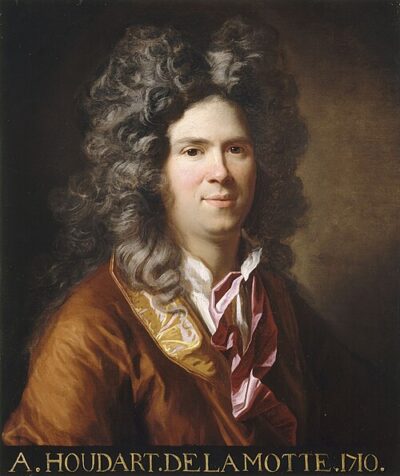
Antoine Houdar de La Motte
Antoine Houdar de La Motte was a French author. Born January 17, 1672, in Paris. Died December 26, 1731, in Paris. Positions held include Member of the Académie française (1710–1731).
Facts
15 facts · 1 confirmed by two sources · 7 cited · 6 from one source · 1 where the sources disagree
What’s different
- Born: we show January 17, 1672 (Sources disagree). Wikipedia says January 18, 1672
Where this comes from
Papalocal keeps its own record. It started from these sources; what each one said is kept here as it was copied, so a change on their side never changes this page by itself. Tap one to read its version.
What Wikidata says · copied November 18, 2026 · revision 2568111281
- Described as
- French author (1672–1731)
- Other names
- Houdar de la Motte, Antoine Houdar de la Motte, Antoine Houdart de La Motte, Antoine Houdart de la Motte
- Born
- January 17, 1672 · 3 references
- Died
- December 26, 1731 · 5 references
- Born in
- Paris · 1 reference
- Died in
- Paris · 1 reference
- Citizen of
- France
- Occupation
- choreographer; writer · 2 references; librettist · 1 reference; playwright; poet; composer; fabulist; ballet master · 1 reference
- Positions held
- Member of the Académie française (1710–1731) · 1 reference
- Member of
- Académie Française (1710–1731) · 1 reference
- Wikipedias with a page
- 21
Wikidata item Q586389 (wikidata.org/wiki/Q586389), public domain (CC0). Copied November 18, 2026.
What Wikipedia says · copied November 18, 2026 · revision 1370611802
Antoine Houdar de la Motte (18 January 1672 – 26 December 1731) was a French writer.
De la Motte was born and died in Paris. In 1693 his comedy, Les Originaux (Les originaux, ou, l'Italien), was a complete failure, and so depressed the author that he contemplated joining the Trappists. Four years later he began writing texts for operas and ballets, e.g. L'Europe galante (1697), and tragedies, one of which, Inès de Castro (1723), was an immense success at the Theâtre Français. He was a champion of the moderns in the revived controversy of the ancients and moderns. His Fables nouvelles (1719) was regarded as a modernist manifesto. Anne Dacier had published (1711) a translation of the Iliad, and La Motte, who knew no Greek, made a translation (1714) in verse founded on her work.
He said of his own work: "I have taken the liberty to change what I thought disagreeable in it." He defended the moderns in the Discours sur Homère prefixed to his translation, and in his Réflexions sur la critique (1716). Apart from the merits of the controversy, it was conducted on La Motte's side with a wit and politeness which compared very favourably with his opponents' methods. He was elected to the Académie Française in 1710, but soon afterwards went blind. La Motte carried on a correspondence with the duchesse du Maine, and was the friend of Fontenelle. He had the same freedom from prejudice and the same inquiring mind as the latter, and it is on the excellent prose in which his views are expressed that his reputation rests.
His Œuvres du theâtre (2 vols.) appeared in 1730, and his Œuvres (10 vols.) in 1754. See Hippolyte Rigault, Histoire de la querelle des anciens et des modernes (1859).
- Born, in its opening lines
- January 18, 1672
- Died, in its opening lines
- December 26, 1731
From the Wikipedia article “Antoine Houdar de la Motte” (en.wikipedia.org/wiki/Antoine_Houdar_de_la_Motte), by its contributors, under CC BY-SA 4.0 (creativecommons.org/licenses/by-sa/4.0/). Copied November 18, 2026; not changed.
Confirmed Two sources agree. Cited One source, and it names where it got it. One source One source, without a reference of its own. Sources disagree The sources disagree. We show the best-supported value and keep theirs below.
