
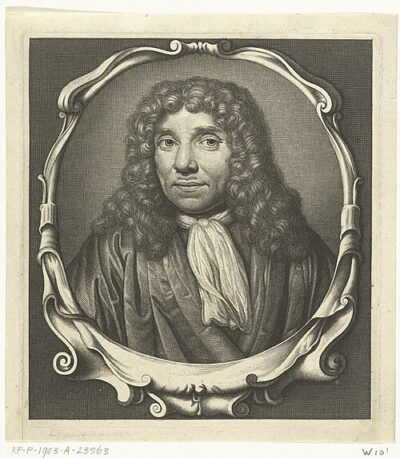
Antonie van Leeuwenhoek
Antonie van Leeuwenhoek was a Dutch scientist known as "the Father of Microbiology", and one of the first microscopists. Born October 24, 1632, in Delft. Died August 26, 1723, in Delft. Positions held include chamberkeeper (1660–1699). Awards include Fellow of the Royal Society.
Facts
24 facts · 2 confirmed by two sources · 14 cited · 8 from one source
Where this comes from
Papalocal keeps its own record. It started from these sources; what each one said is kept here as it was copied, so a change on their side never changes this page by itself. Tap one to read its version.
What Wikidata says · copied November 16, 2026 · revision 2564346201
- Described as
- Dutch scientist known as "the Father of Microbiology", and one of the first microscopists (1632–1723)
- Other names
- Antonie Van Leeuwenhoek, Anton van Leeuwenhoek, Antonie Philips van Leeuwenhoek
- Born
- October 24, 1632 · 9 references
- Died
- August 26, 1723 · 6 references
- Born in
- Delft · 4 references
- Died in
- Delft · 4 references
- Buried in
- Oude Kerk · 1 reference
- Citizen of
- Dutch Republic
- Occupation
- biologist · 1 reference; physicist · 1 reference; instrument maker · 1 reference; merchant; microbiologist · 1 reference; accountant (1648) · 1 reference; treasurer (1648) · 1 reference; surveyor (1669) · 1 reference
- Positions held
- chamberkeeper (1660–1699) · 1 reference
- Member of
- Royal Society of London (1680–)
- Awards
- Fellow of the Royal Society
- Field
- microscopy; microbiology
- Spouse
- Barbara de Mey (1654–) · 1 reference; Cornelia Swalmius (1671–) · 1 reference
- Father
- Philips Antonisz. van Leeuwenhoek · 2 references
- Mother
- Margaretha Bel van der Berch · 2 references
- Lived in
- Netherlands · 1 reference
- Wikipedias with a page
- 109
Wikidata item Q43522 (wikidata.org/wiki/Q43522), public domain (CC0). Copied November 16, 2026.
What Wikipedia says · copied November 16, 2026 · revision 1381835242
Antonie Philips van Leeuwenhoek ( AHN-tə-nee vahn LAY-vən-hook, -huuk; Dutch: [ˈɑntoːni vɑn ˈleːu.ə(n)ˌɦuk] ; 24 October 1632 – 26 August 1723) was a Dutch microbiologist and microscopist in the Golden Age of Dutch art, science and technology. A largely self-taught man in science, he is commonly known as "the Father of Microbiology", and one of the first microscopists and microbiologists. Van Leeuwenhoek is best known for his pioneering work in microscopy and for his contributions toward the establishment of microbiology as a scientific discipline.
Raised in Delft, Dutch Republic, Van Leeuwenhoek worked as a draper in his youth and founded his own shop in 1654. He became well-recognized in municipal politics and developed an interest in lensmaking. In the 1670s, he started to explore microbial life with his microscope.
Using single-lensed microscopes of his own design and make, Van Leeuwenhoek was the first to observe and to experiment with microbes, which he originally referred to as dierkens, diertgens or diertjes. He was the first to relatively determine their size. Most of the "animalcules" are now referred to as unicellular organisms, although he observed multicellular organisms in pond water. He was also the first to document microscopic observations of muscle fibers, bacteria, spermatozoa, red blood cells, and crystals in gouty tophi, and was among the first to see blood flow in capillaries. Although Van Leeuwenhoek did not write any books, he described his discoveries in chaotic letters to the Royal Society, which published many of his letters in their Philosophical Transactions.
- Born, in its opening lines
- October 24, 1632
- Died, in its opening lines
- August 26, 1723
From the Wikipedia article “Antonie van Leeuwenhoek” (en.wikipedia.org/wiki/Antonie_van_Leeuwenhoek), by its contributors, under CC BY-SA 4.0 (creativecommons.org/licenses/by-sa/4.0/). Copied November 16, 2026; not changed.
Confirmed Two sources agree. Cited One source, and it names where it got it. One source One source, without a reference of its own. Sources disagree The sources disagree. We show the best-supported value and keep theirs below.
